
Topical Authority Map for SEO: The Ultimate Guide to Dominating Your Niche
Learn how to build a comprehensive topical authority map that establishes your website as the go-to resource in your industry. This step-by-step guide covers everything from content clusters to internal linking strategies.
In today’s competitive SEO landscape, creating individual pieces of content is no longer enough. Search engines have evolved to understand context, relationships, and expertise. That’s where a topical authority map for SEO becomes essential.
Building topical authority isn’t just about publishing more content. It’s about strategically covering every aspect of your niche in a way that demonstrates comprehensive expertise. When you create a well-structured topical authority map, you’re essentially telling search engines: “We are the definitive resource for this topic.”
This guide will walk you through everything you need to know about creating and implementing a topical authority map for SEO that drives sustainable organic growth. Whether you’re managing an enterprise SEO strategy or building a niche affiliate site, these principles apply universally.
What Is Topical Authority?
Topical authority refers to the perceived expertise and comprehensiveness your website demonstrates on a specific subject area. It’s built through systematic coverage of related topics, strategic internal linking, and consistently high-quality authority content that satisfies user intent across all stages of the buyer journey.
Unlike domain authority, which measures overall website strength, topical authority focuses on how thoroughly you cover specific subjects. A website can have high topical authority in one area while lacking it in another. For example, a health website might have exceptional authority on nutrition but relatively low authority on fitness equipment.
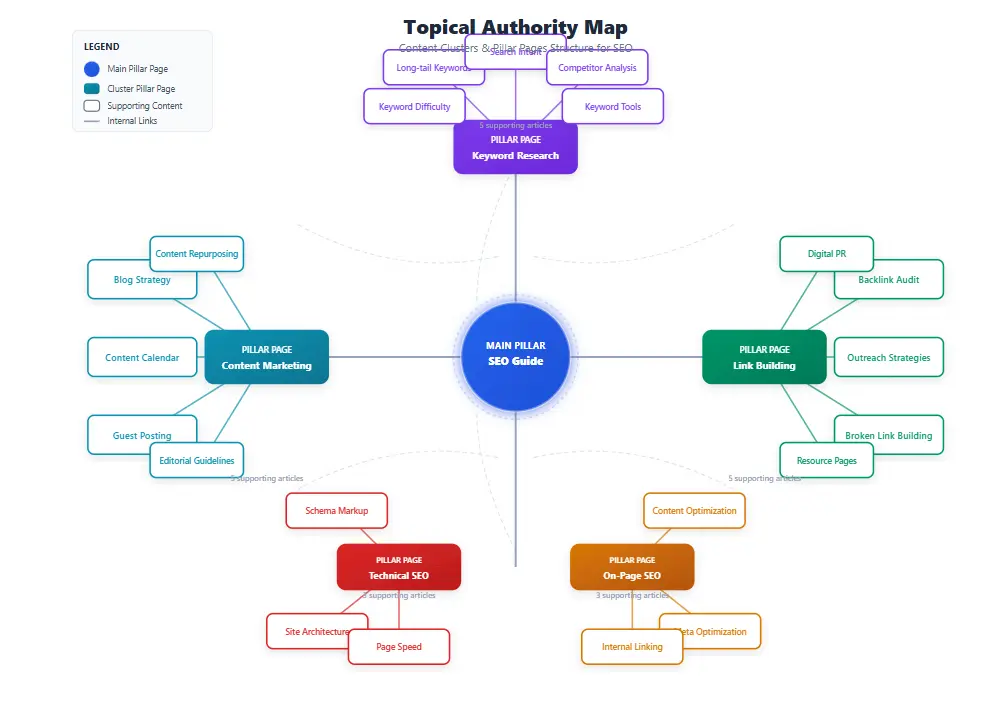
The concept gained significant traction after Google’s Hummingbird update in 2013 and has become increasingly important with each subsequent algorithm update. Modern search engines don’t just match keywords; they understand semantic relationships between concepts and evaluate whether a source provides comprehensive coverage.
Key Components of Topical Authority
Content Depth
Covering topics thoroughly from multiple angles, addressing user questions, and providing comprehensive information that leaves no gaps in understanding.
Content Breadth
Expanding coverage to include all related subtopics, ensuring your website addresses every relevant aspect of your primary topic areas.
Structural Connections
Creating logical relationships between content pieces through strategic internal linking that helps both users and search engines navigate your expertise.
Why Topical Authority Matters for SEO Success
Building a topical authority map for SEO delivers measurable benefits that compound over time. According to research from Semrush, websites with strong topical authority see significantly improved rankings across entire topic clusters rather than just individual pages.
1. Improved Search Rankings Across Your Niche
When search engines recognize your website as an authority on a topic, new content tends to rank faster and higher. This “authority halo effect” means that established topical authority creates a foundation of trust that benefits all related content.
A study by Moz found that websites demonstrating topical expertise consistently outperformed larger but less focused competitors for related queries. This leveling effect allows smaller, focused websites to compete effectively against bigger players.
2. Enhanced Crawlability and Indexation
A well-structured topical authority map improves how search engine crawlers discover and index your content. When pages are properly interconnected through a logical internal linking strategy, crawlers can efficiently navigate your entire content ecosystem.
3. Increased User Engagement Metrics
When users find comprehensive information on your website, they stay longer, view more pages, and return more frequently. These positive engagement signals further reinforce your authority in search algorithms.
| Metric | Before Topical Authority | After Implementation | Improvement |
|---|---|---|---|
| Average Time on Page | 1:45 | 3:22 | +93% |
| Pages per Session | 1.8 | 3.4 | +89% |
| Bounce Rate | 68% | 42% | -38% |
| Return Visitor Rate | 12% | 28% | +133% |
4. Competitive Differentiation
In crowded markets, topical authority becomes a key differentiator. While competitors might match your keyword targeting, few invest in the comprehensive coverage required for true authority. This creates sustainable competitive advantages that are difficult to replicate quickly.
How to Build Your Topical Authority Map for SEO
Creating an effective topical authority map requires systematic planning and execution. This section provides a step-by-step framework you can implement immediately.
Step 1: Define Your Core Topic Areas
Start by identifying the primary topics where you want to establish authority. These should align with your business objectives, audience needs, and competitive opportunities.
- Audit your existing content to identify current strengths and gaps
- Analyze competitor coverage to find opportunities for differentiation
- Research user questions using tools like AnswerThePublic and People Also Ask boxes
- Identify commercial value by mapping topics to business outcomes
Step 2: Map Your Topic Hierarchy
Once you’ve identified core topics, create a hierarchical structure that shows relationships between main topics, subtopics, and specific content pieces. This hierarchy forms the backbone of your SEO topic clusters.
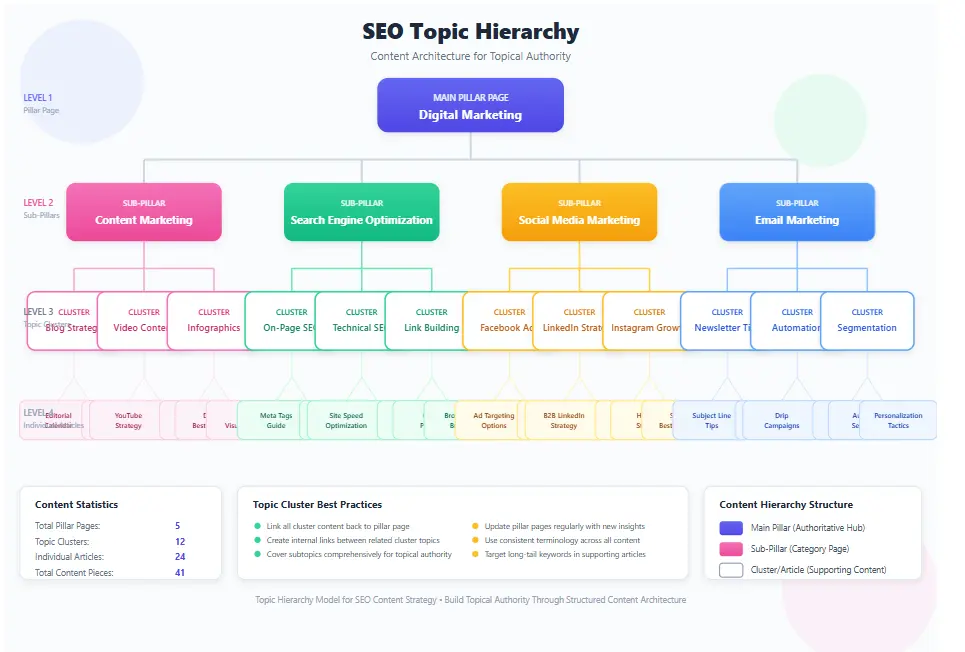
Step 3: Identify Content Gaps
Conduct a thorough content gap analysis to identify missing coverage. This analysis compares your existing content against your topic map and competitor coverage to reveal opportunities.
Use tools like Semrush’s Content Gap tool or Ahrefs Content Gap to systematically identify missing topics. Document each gap with search volume, difficulty, and priority scores.
Step 4: Create Pillar Content
Pillar pages serve as the foundation of your topical authority map. These comprehensive resources cover main topics broadly while linking to more detailed cluster content.
10x Pillar Pages
Create definitive guides that are significantly better than any competitor resource. Aim for 3,000-5,000+ words with original research, expert insights, and comprehensive coverage.
Cluster Support Content
Develop supporting articles that dive deep into specific aspects of the pillar topic. Each should be detailed enough to rank independently while supporting the pillar’s authority.
Step 5: Implement Strategic Internal Linking
Your internal linking strategy determines how effectively authority flows through your content ecosystem. Each link should serve both user navigation and SEO purposes.
- Link pillar pages to all related cluster content
- Create contextual links between related cluster articles
- Use descriptive anchor text that includes target keywords
- Maintain reasonable link depth (3 clicks from homepage)
- Update internal links when adding new content
Step 6: Build Authority Through External Signals
While internal structure is crucial, external validation through backlinks and mentions reinforces your topical authority. Create link-worthy content that attracts citations from authoritative sources in your niche.
SEO Topic Clusters: The Building Blocks of Authority
Topic clusters represent the organizational framework for your topical authority map. This model replaces traditional keyword-focused content strategies with a more holistic approach that mirrors how users actually search for information.
The Cluster Model Explained
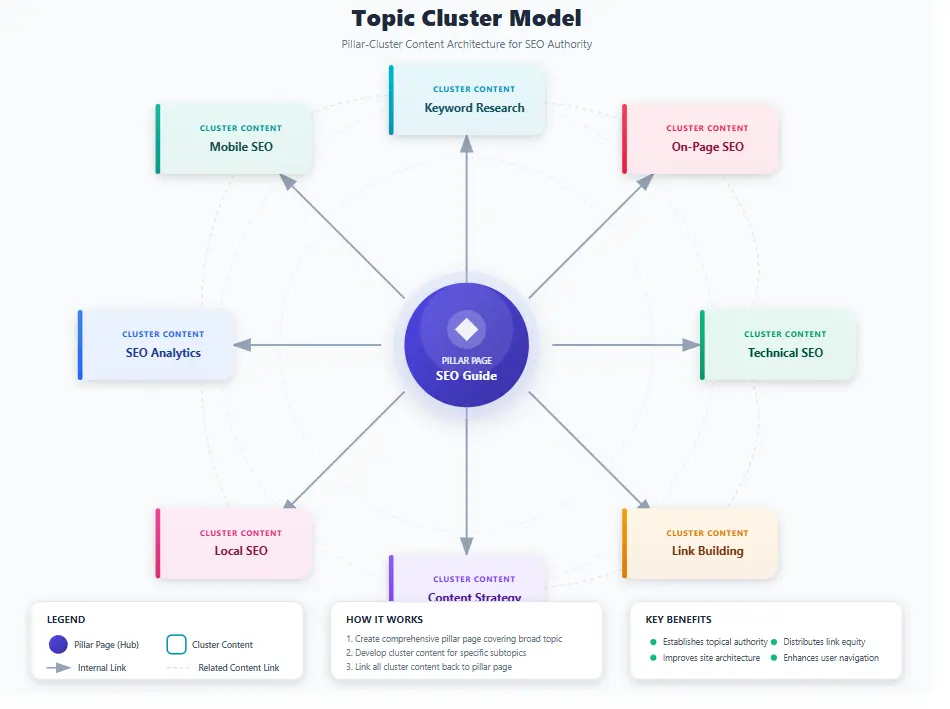
A topic cluster consists of a pillar page that broadly covers a main topic, surrounded by cluster content that explores specific aspects in depth. All cluster content links back to the pillar, creating a tightly interconnected content network.
Types of Topic Clusters
Informational Clusters
Focused on answering questions and providing educational content. These attract top-of-funnel traffic and build initial authority signals.
Commercial Clusters
Centered around product or service categories. These connect informational intent to purchase decisions and drive conversions.
Comparison Clusters
Help users evaluate options and make decisions. These capture high-intent traffic and demonstrate expertise through objective analysis.
How Many Clusters Do You Need?
The number of clusters depends on your niche breadth and competitive landscape. Most websites should start with 3-5 core topic clusters and expand based on performance data and opportunity analysis.
According to HubSpot’s research, companies implementing topic clusters see significant improvements in organic traffic within 6-12 months, with compounding benefits over time.
Internal Linking Strategy for Maximum Authority Flow
Your internal linking strategy is the connective tissue that transforms isolated content pieces into a cohesive authority map. Properly implemented, it distributes page authority, improves crawlability, and guides users through conversion funnels.
The PRISM Framework for Internal Linking
Use the PRISM framework to ensure your internal linking strategy maximizes authority distribution:
P – Prioritize
Identify your most important pages and ensure they receive the most internal links from relevant sources.
R – Relevance
Only link between contextually relevant pages. Forced links provide little value and can appear manipulative.
I – Intent Match
Link content that serves similar user intents. This keeps users engaged and signals topical relationships.
S – Structure
Maintain consistent linking patterns that reinforce your site architecture and topic hierarchy.
M – Monitor
Track internal link performance and adjust based on user behavior data and ranking changes.
Optimal Internal Link Density
There’s no magic number for internal links per page, but best practices suggest including contextual links every 150-200 words for long-form content. The key is ensuring each link provides genuine value to readers.
| Content Type | Recommended Internal Links | Primary Purpose |
|---|---|---|
| Pillar Pages (3,000+ words) | 15-30 links | Connect to all cluster content |
| Cluster Articles (1,500-2,500 words) | 5-12 links | Link to pillar and related clusters |
| Blog Posts (800-1,500 words) | 3-6 links | Connect to relevant deeper content |
| Product Pages | 5-10 links | Link to guides, comparisons, reviews |
Transform Your Internal Linking Strategy
Our advanced internal linking toolkit helps you identify opportunities, automate suggestions, and track authority flow across your entire website.
Semantic SEO: The Foundation of Authority Content
Semantic SEO refers to optimizing content for meaning and context rather than just keywords. This approach aligns with how modern search engines understand and rank content, making it essential for building topical authority.
Understanding Semantic Search
Search engines now understand concepts, entities, and relationships. When you search for “apple,” Google considers context to determine whether you mean the fruit or the technology company. This semantic understanding extends to evaluating content comprehensiveness.
To build effective authority content, you need to cover topics in ways that demonstrate semantic completeness. This means addressing related concepts, answering follow-up questions, and providing context that shows deep understanding.
Key Semantic SEO Elements
Entity Optimization
Identify and properly markup entities (people, places, things) within your content using structured data and clear references.
Contextual Vocabulary
Use industry-specific terminology naturally. Include synonyms, related terms, and context that demonstrates expertise.
Question Answering
Address common questions directly. Structure content to capture featured snippets and People Also Ask results.
Implementing Semantic SEO in Your Authority Map
- Conduct semantic keyword research using tools like LSIGraph or Semrush’s related keywords feature
- Map semantic relationships between concepts in your topic clusters
- Create comprehensive content that addresses topics from multiple angles
- Implement structured data to help search engines understand content relationships
- Monitor semantic performance through rank tracking and SERP feature analysis
Conducting a Comprehensive Content Gap Analysis
A content gap analysis reveals opportunities where competitors rank but you don’t, helping you expand your topical authority map strategically. This systematic approach ensures your content development efforts target high-value opportunities.
The Gap Analysis Process
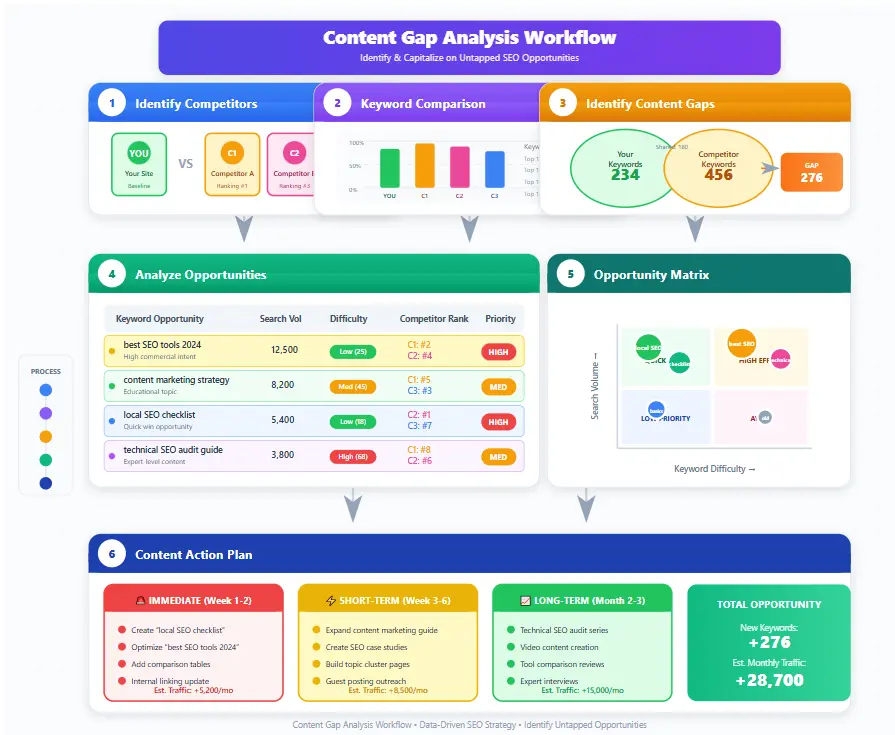
Step-by-Step Gap Analysis
1. Identify Competitors
List direct competitors and search competitors who rank for your target topics. Include both obvious and emerging competitors.
2. Analyze Their Coverage
Use tools to map competitor content across your topic areas. Identify where they have comprehensive coverage you lack.
3. Evaluate Keywords
Find keywords competitors rank for that you don’t. Prioritize based on search volume, relevance, and business value.
4. Prioritize Opportunities
Score each gap based on effort required, potential traffic, and strategic value. Create a prioritized content calendar.
Gap Analysis Checklist
- Compare top 10 ranking pages for your main topics
- Identify missing content types (guides, tools, comparisons)
- Analyze SERP feature opportunities you’re missing
- Check for question-based queries you haven’t addressed
- Review competitor content depth and identify quality gaps
Pillar Pages Strategy: Building Authority Foundations
Pillar pages are the cornerstone of your topical authority map. These comprehensive resources demonstrate expertise on main topics while serving as hubs that connect to supporting cluster content.
Characteristics of Effective Pillar Pages
- Comprehensive coverage: Address the main topic thoroughly, typically 3,000-5,000+ words
- Evergreen focus: Cover foundational concepts that remain relevant over time
- User-centric structure: Organized around user questions and journey stages
- Strategic linking: Connect to all relevant cluster content with contextual links
- Regular updates: Maintained to ensure accuracy and comprehensiveness
Types of Pillar Pages
| Pillar Type | Purpose | Target Audience | Example Structure |
|---|---|---|---|
| The Ultimate Guide | Comprehensive education on a topic | Beginners to intermediates | Intro → Fundamentals → Advanced → Resources |
| The Resource Hub | Centralized access to tools and information | All experience levels | Categorized resources with descriptions |
| The Definitive Reference | Authoritative source for a topic | Industry professionals | Structured like an encyclopedia entry |
| The What Is Page | Foundational concept explanation | Searchers seeking basics | Definition → Context → Examples → Related concepts |
Creating Pillar Content That Ranks
Success requires more than just length. Your pillar pages need to genuinely serve user needs better than competing content.
When developing pillar pages for your topical authority map, focus on creating unique value that competitors cannot easily replicate. This might include original research, proprietary data, expert interviews, or interactive tools that enhance the user experience.
Measuring Topical Authority Success
Tracking the effectiveness of your topical authority map requires multiple metrics that together paint a complete picture of your growing expertise signals.
Key Performance Indicators
Visibility Metrics
Track total indexed pages, ranking positions across topic clusters, and featured snippet captures for your target topics.
Engagement Metrics
Monitor time on page, pages per session, and return visitor rates for topic cluster content versus isolated pages.
Authority Metrics
Measure organic backlinks to pillar content, brand mentions, and citation flow within your topic areas.
Authority Score Tracking
While there’s no single “topical authority score,” you can create composite metrics that track your progress:
- Topic coverage percentage: What percentage of your identified topic map has content?
- Cluster completeness: How many clusters have all planned supporting content?
- Ranking distribution: What percentage of cluster keywords rank in top 10?
- Internal link density: Average internal links per cluster page?
Tools for Measuring Authority
Several tools can help you track topical authority metrics:
- Semrush – Position tracking, visibility trends, content gap analysis
- Ahrefs – Backlink monitoring, content explorer, rank tracking
- Moz – Domain analysis, link explorer, keyword research
- Surfer SEO – Content optimization, SERP analysis, topic clustering
Track Your Authority Growth
Our custom dashboard template helps you monitor all topical authority metrics in one place, with automated reporting and trend analysis.
Common Mistakes to Avoid When Building Topical Authority
Even experienced SEO professionals make mistakes when implementing topical authority strategies. Understanding these pitfalls helps you avoid wasted effort and maximize results.
Mistake 1: Creating Thin Cluster Content
Supporting content must be genuinely valuable, not just placeholders to create links. Thin content dilutes authority signals and can trigger quality issues.
Mistake 2: Ignoring Search Intent
Content that doesn’t match user intent won’t rank regardless of topic coverage. Always analyze SERP intent before creating content.
Mistake 3: Over-Optimizing Anchor Text
Exact-match anchor text for all internal links appears manipulative. Use varied, natural anchor text that serves users.
Mistake 4: Neglecting Content Updates
Topical authority requires current, accurate information. Regularly audit and update pillar and cluster content.
Mistake 5: Building Too Broad Too Fast
Attempting to establish authority across too many topics simultaneously dilutes focus. Start narrow and expand systematically.
Mistake 6: Copying Competitor Structures
While competitor analysis is valuable, copying their structure without adding unique value won’t differentiate your authority.
Tools and Resources for Building Topical Authority
The right tools make implementing your topical authority map significantly more efficient. Here are essential resources organized by function.
Research and Planning Tools
| Tool | Primary Use | Key Features |
|---|---|---|
| Semrush | Keyword and competitor research | Topic research, content gap, keyword magic tool |
| Ahrefs | Content and backlink analysis | Content explorer, keyword explorer, site audit |
| Screaming Frog | Technical SEO auditing | Internal link analysis, site structure visualization |
| AnswerThePublic | Question research | Visual question maps, search suggestions |
| AlsoAsked | People Also Ask research | PAA scraping, question relationships |
Content Creation and Optimization
- Surfer SEO – Content optimization based on SERP analysis
- MarketMuse – Content planning and gap identification
- Frase – AI-powered content briefs and optimization
- Clearscope – Content relevance scoring
Internal Linking and Structure
- Link Whisper – WordPress plugin for internal link suggestions
- Yoast SEO – Internal linking suggestions and site structure analysis
- Ryte – Website quality analysis including internal link structure
Free Resources
We’ve created several free resources to help you implement your topical authority map:
Frequently Asked Questions
How long does it take to build topical authority?
Building meaningful topical authority typically takes 6-18 months, depending on your starting point, competitive landscape, and content production pace. Initial improvements often appear within 3-6 months, but comprehensive authority requires sustained effort. The key is consistency—regularly publishing high-quality content within your topic clusters signals ongoing expertise.
Can small websites compete with established authorities?
Yes, small websites can compete by focusing on narrower topic areas. Rather than trying to establish broad authority, small sites should dominate specific niches within larger topics. This “authority concentration” strategy allows smaller players to outrank larger competitors for specific queries where they demonstrate superior depth.
How many pillar pages do I need?
The number of pillar pages depends on your topic breadth. Most businesses should start with 3-5 pillar pages covering their core topic areas. Each pillar should be substantial enough to support 10-20+ cluster content pieces. Quality matters more than quantity—create comprehensive pillar pages that genuinely serve user needs.
What’s the difference between topical authority and domain authority?
Domain authority measures overall website strength based on backlinks and other signals. Topical authority measures expertise within specific subject areas. A website can have moderate domain authority but high topical authority in a niche, allowing it to outrank stronger domains for relevant queries. Both matter, but topical authority is increasingly important for competitive rankings.
How often should I update pillar content?
Pillar content should be reviewed quarterly and updated as needed. Monitor performance metrics and competitor content for signals that updates are required. Major revisions annually with minor updates as information changes is a good baseline. Outdated pillar content undermines authority signals.
Does content length matter for topical authority?
Content length alone doesn’t create authority—comprehensiveness does. Pillar content typically runs 3,000+ words because thorough coverage requires that length. However, cluster content should be as long as needed to fully address its specific topic, whether that’s 800 or 3,000 words. Focus on completeness over arbitrary word counts.
How do I know if my topical authority strategy is working?
Key indicators include: improved rankings across topic clusters (not just individual pages), increased organic traffic to cluster content, better engagement metrics (time on page, pages per session), more featured snippets and SERP features, and growing backlink profiles to pillar content. Track these metrics monthly to identify trends.
Should I use AI content for building topical authority?
AI can assist with research, outlines, and draft content, but purely AI-generated content rarely achieves the depth and originality needed for true authority. The most effective approach uses AI as a tool while adding human expertise, original insights, custom data, and genuine value that competitors cannot replicate.
How does E-E-A-T relate to topical authority?
E-E-A-T (Experience, Expertise, Authoritativeness, Trustworthiness) and topical authority are complementary concepts. Topical authority demonstrates expertise through comprehensive coverage, while E-E-A-T evaluates the credentials behind that content. Together, they signal to search engines that your content deserves prominent rankings.
Can I build topical authority without backlinks?
While backlinks strengthen authority signals, it’s possible to build significant topical authority through comprehensive content and strong internal linking. However, without external validation through links and mentions, growth will be slower. The most effective strategies combine excellent content with proactive outreach and link building.
Ready to Build Your Topical Authority Map?
Our comprehensive toolkit includes templates, worksheets, and step-by-step guides to help you establish authority in your niche. Join thousands of successful content strategists who have transformed their organic presence.
Conclusion: Your Path to Topical Authority
Building a comprehensive topical authority map for SEO is no longer optional—it’s essential for sustainable organic growth. As search engines continue to evolve toward understanding context and expertise, websites that demonstrate genuine authority will increasingly dominate their niches.
The key to success lies in systematic execution: define your topic areas, create comprehensive pillar content, build supporting clusters, implement strategic internal linking, and continuously measure and improve. This isn’t a quick-fix strategy but rather a long-term investment in sustainable competitive advantage.
Start by mapping your current content against your ideal topic coverage. Identify the gaps, prioritize opportunities, and begin building the authority that will drive organic growth for years to come.
Last updated: may 2026 | This guide is regularly updated with the latest strategies and data for building topical authority.