
E-E-A-T Checklist + Free Template: Build Trust, Authority, and Better Rankings
A practical, page-by-page E-E-A-T checklist you can use for audits, updates, affiliate reviews, and service pages—without fluff.
If you’ve ever asked “Why isn’t this page ranking even though the SEO looks fine?”, you’re probably missing trust signals. This guide is a hands-on E-E-A-T checklist you can run on any site—affiliate, service, ecommerce, or content blog—to strengthen credibility, reduce “thin content” risk, and improve how people (and Google) evaluate quality. You’ll get a complete E-E-A-T checklist for Experience, Expertise, Authoritativeness, and Trust, plus page-by-page fixes, quick wins, reusable blocks, and a scoring rubric you can use in real audits.
Treat this E-E-A-T checklist like a “proof system.” It’s not about adding fancy words—it’s about adding evidence: who wrote the content, why they’re qualified, what was tested, where facts come from, what changed over time, and how users can verify you’re real. When your proof is visible, trust grows. When trust grows, rankings and conversions often improve together.
- Advanced SEO audit checklist — use it to prove your process and document fixes.
- Ecommerce SEO audit checklist — use it when your site sells or reviews products.
- Best SEO report template — use it to track changes and show progress.
- Free keyword research template — use it to build topic depth and avoid thin content.
- Internal linking template — use it to build authority and guide crawlers/users.
- Best all-in-one SEO tools — use it when you cite your tool stack transparently.
Use these links where they make sense: audits support your proof, templates support your process, and internal linking supports authority.
What E-E-A-T means (and what it doesn’t)
E-E-A-T stands for Experience, Expertise, Authoritativeness, and Trust. In simple terms: it’s how you demonstrate content quality and credibility—especially on topics where people need accurate, safe, and reliable guidance. A strong E-E-A-T checklist focuses on what readers can verify, not what you claim.
Here’s the mindset shift: people don’t “believe” content because it’s long. They believe content because it’s backed by proof. That proof can be a clear author identity, relevant experience, citations, transparent disclosures, a consistent editorial policy, and a website that looks like a real business (not a thin affiliate shell). This E-E-A-T checklist is designed to help you build that proof.
- A proof framework: visible evidence your content and brand are reliable.
- A user-first system: remove doubt so visitors trust your recommendations.
- A set of signals: author info, transparency, citations, policies, reputation, and experience proof.
- A consistency standard: applied site-wide so users see the same quality across pages.
Official resources: Creating helpful content and SEO Starter Guide.
- Not a plugin: you can’t “install EEAT.” You implement signals over time.
- Not only backlinks: authority helps, but trust gaps can still limit performance.
- Not keyword repetition: repeating “E-E-A-T checklist” isn’t a substitute for proof.
- Not fake credibility: invented credentials, fake reviews, or fake screenshots destroy trust.
Many sites treat E-E-A-T like a “bio box” problem. They add a short author bio and hope rankings jump. But an effective E-E-A-T checklist is broader: it includes editorial standards, update behavior, disclosures, citations, and page-level proof. Think “trust architecture,” not “one widget.”
Why E-E-A-T matters for rankings (especially YMYL)
E-E-A-T matters most when users need to trust what they’re reading. That’s why it’s especially important for “Your Money or Your Life” (YMYL) topics: health, finance, legal, safety, and any content that can impact a person’s wellbeing. If the downside risk of bad advice is high, Google and users both expect stronger proof. A strong E-E-A-T checklist is basically a risk-reduction system.
But E-E-A-T isn’t just for YMYL. On competitive commercial queries—services, tools, “best” lists—trust signals are often what separate top performers. When two pages cover similar keywords, the one that feels more credible wins more clicks and keeps users engaged longer. Engagement is not magic by itself; it’s often a symptom of “this is trustworthy and useful.” That’s exactly what your E-E-A-T checklist supports.
- Fewer doubts: clear author identity and proof reduce bounce.
- Better scanning: checklists, summaries, and callouts improve readability.
- Higher CTA trust: people convert when they feel safe.
- Better lead quality: transparent pages attract serious users, not “freebie-only” traffic.
Additional official references you can cite in policy pages: Structured data intro, Google Search guidance, Core updates guidance.
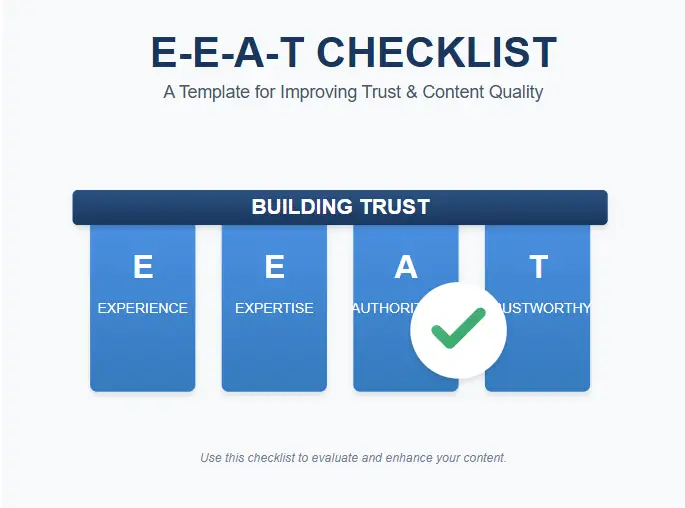
Download: E-E-A-T checklist template
Want the shortcut? Download the printable E-E-A-T checklist PDF and use it to audit pages fast, assign fixes, and track improvements. This template is designed for real work: one-page quick checks, page-by-page checks, site-wide trust checks, and a QA verification list.
No spam. Practical checklist + examples.
- Checklist PDF: a clean, printable E-E-A-T checklist for quick audits.
- On-page checklist: blocks for posts, service pages, and reviews.
- Site-wide checklist: policies, trust pages, brand/entity signals.
- QA list: verification steps (accuracy, links, disclosures, updates).
The E-E-A-T checklist (Experience, Expertise, Authority, Trust)
This section is the main E-E-A-T checklist. Use it in two passes: (1) a fast pass to find gaps, and (2) a deep pass on pages that matter most (money pages, high-traffic pages, high-risk YMYL pages). If you want the audit process to be repeatable, combine this E-E-A-T checklist with your advanced SEO audit checklist and document changes inside your best SEO report template.
Experience signals (first-hand proof)
“Experience” answers: did you actually do the thing? For tool reviews, it means you used the tool. For tutorials, it means you tested the steps. For service pages, it means you’ve delivered outcomes and can show examples (without exaggeration). The most effective E-E-A-T checklist makes experience visible in a way readers can trust.
- First-hand context: what you did/tested/observed is stated clearly.
- Original media: screenshots/photos show real steps or real results (where appropriate).
- Testing notes: timeframe, criteria, limitations, and environment.
- Edge cases: “what didn’t work” and “when this doesn’t apply.”
- Practical insights: small details only a real user would mention.
- Update behavior: you revise when the tool/product/process changes.
Quick win: add a “What we noticed” paragraph after your intro. It can dramatically increase trust signals in your E-E-A-T checklist.
- Tool review: “We tested the reporting feature on 3 projects and noticed the export format limitation.”
- Service page: “Here’s a sample deliverable preview and our exact step-by-step workflow.”
- Tutorial: “Step 4 is where most people get stuck; here’s the fix and why it works.”
- Audit guide: “Here are the top 5 issues we repeatedly see during audits.”
When you document this, your E-E-A-T checklist becomes evidence-based instead of opinion-based.
Expertise signals (skill + accuracy)
Expertise is about competence and correctness. You don’t need to claim credentials you don’t have. You do need to demonstrate that your content is accurate, complete, and helpful for the user’s intent. The best E-E-A-T checklist includes clarity, definitions, correct terminology, and citations for key facts. It also includes content hygiene: removing outdated advice and tightening unclear sections.
- Named author: avoid “Admin” on important pages.
- Bio depth: relevant background, niche focus, and what they do.
- Intent coverage: the page answers the main question completely.
- Accuracy controls: citations for facts; careful language for uncertain points.
- Helpful structure: steps, tables, checklists, examples.
- Freshness: update old sections; add an update log for transparency.
To expand topical coverage without thin content, plan clusters with the free keyword research template.
Add one short section titled “Common mistakes” or “What most people miss.” This shows applied expertise and improves your E-E-A-T checklist. Keep it honest: explain why the mistake happens and how to avoid it.
Authoritativeness signals (reputation + entity)
Authoritativeness is how the web perceives your brand and your authors. It includes mentions, reputation, consistency, and internal depth. You can build authority without huge PR by publishing high-quality clusters and linking them intelligently. That’s why a complete E-E-A-T checklist includes internal linking as an authority signal: it helps crawlers understand hierarchy and helps users find more helpful answers without leaving.
- Brand/entity clarity: consistent brand name, logo, about info site-wide.
- Proof of existence: real contact methods and business details.
- Mentions: show real testimonials, case studies, or references (never fake).
- Internal authority: no orphan pages; link supporting guides to cornerstone pages.
- External references: cite reputable sources and official docs when possible.
Use the internal linking template to systemize authority building.
Authority signals should feel boring—in a good way. Real “About” info, real authors, real processes, real examples. If your site looks like a real business and your content reads like it’s written by a real practitioner, your E-E-A-T checklist is working.
Trust signals (transparency + safety)
Trust is the foundation. Even if you have experience and expertise, a site can still feel risky if policies are hidden, contact methods look fake, or disclosures are unclear. Trust signals reduce user doubt and support long-term performance. The most reliable E-E-A-T checklist includes transparency, security, and consistency across every page type.
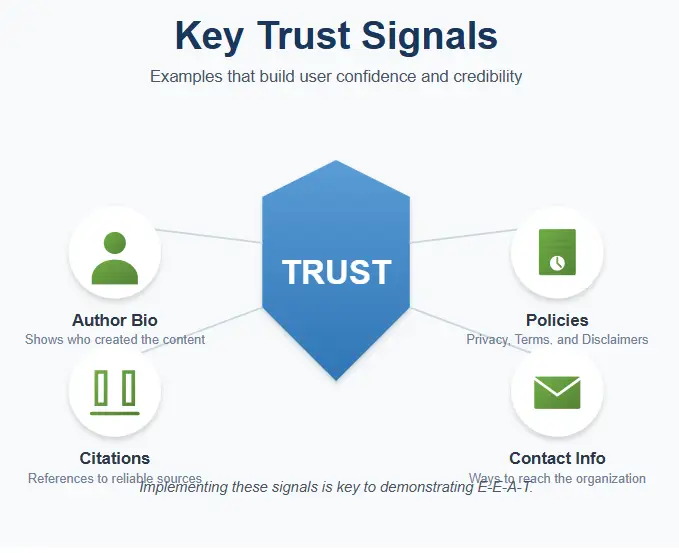
- Clear disclosures: affiliate/sponsorship disclosures are visible and plain-language.
- Policies: privacy policy, terms, editorial policy easy to find.
- Contact details: real email/contact form; address/phone if appropriate.
- Security: HTTPS, clean forms, no suspicious redirects.
- Review integrity: balanced pros/cons and honest limitations.
- Corrections path: allow feedback and fix errors fast.
Some pages may include affiliate links. If you buy through them, we may earn a commission at no extra cost to you. We aim to keep recommendations honest by explaining our criteria, experience, and limitations. Transparency is part of the E-E-A-T checklist.
Page-by-page E-E-A-T checklist
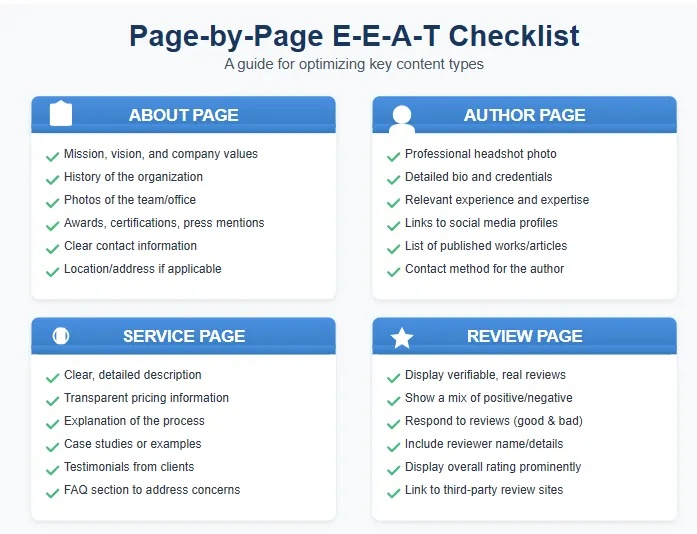
Now we apply the E-E-A-T checklist to real page types. This is where most sites improve quickly because fixes become specific. Use this as an audit worksheet. If you want to document and communicate progress, use the best SEO report template and include before/after screenshots.
Homepage
- Instant clarity: who you help + what you do + why you’re different (without hype).
- Trust blocks: testimonials/case studies/samples (real only).
- Navigation trust: About, Contact, and policy pages are easy to find.
- Proof placement: show examples near CTAs so users feel safe taking action.
- Consistency: match tone and claims with your service and review pages.
If you run audits, link from homepage to your methodology like the advanced SEO audit checklist.
About page
- Real story: why the site exists and what problem you solve.
- Who’s behind it: author/team bios and responsibilities.
- Editorial standards: how you research, review, and update content.
- Disclosure principles: how you handle affiliate links and sponsorships.
- Corrections policy: how users can report errors (and what happens next).
Author page
- Full bio: niche focus, experience, and what the author actually does.
- Credibility links: real professional profiles (no fake badges).
- Content list: show all posts by the author (topical authority).
- Optional reviewer: “Reviewed by” for sensitive categories.
Blog post
- Author + dates: publish date and “last updated” when relevant.
- Sources box: cite key facts and official docs.
- Experience proof: examples, screenshots, or tested notes.
- Internal links: link to supporting guides and templates naturally.
- Reader safety: be cautious with strong claims; include limitations.
Build clusters and avoid thin posts with the free keyword research template.
Review / affiliate page
- Disclosure near top: clear affiliate disclosure before links.
- How you tested: criteria, timeframe, and what you didn’t test.
- Original screenshots: real UI or results (where allowed).
- Balanced verdict: best for / not best for, pros/cons, trade-offs.
- Alternatives: show realistic options and when they’re better.
- Update log: track changes over time (features, pricing, interface).
Don’t hide intent. A strong E-E-A-T checklist makes monetization obvious and honest. If you earn commissions, say so. If you got a free trial, disclose it if relevant. If you didn’t test something, don’t imply you did.
Service page
- Clear deliverables: what the buyer gets (specific, not vague).
- Process steps: timeline, checkpoints, and what you need from the client.
- Proof: case studies, examples, sample audits, sample reports.
- Risk reducers: realistic expectations (avoid guaranteed rankings).
- CTA clarity: simple contact path with response time expectations.
If you reference your tools, link transparently to your stack guide: best all-in-one SEO tools.
Contact page
- Multiple contact methods: form + email (and phone/address if appropriate).
- Response expectation: “We reply within X hours.”
- Privacy near the form: link to privacy policy to reduce friction.
- Consistency: the same brand name and details across the site.
Quick fixes (do these first)
If you want the fastest impact, do these first. They’re the highest-leverage items in this E-E-A-T checklist because they reduce user doubt immediately. Treat this like a sprint: ship these improvements across your top pages before you rewrite everything.
- Add an author box + author page (bio, focus, relevant links).
- Add disclosures on every affiliate/review page (near the top).
- Add a sources box for facts, definitions, and claims.
- Add an update log (“last updated” + what changed).
- Make policies + contact visible in header/footer navigation.
- Fix orphan pages using the internal linking template.
- Reduce friction (remove aggressive popups that block reading).
- Add one proof block per important page (screenshots, examples, sample deliverables).
Avoid fake credentials, fake testimonials, and “as seen in” logos that aren’t real. A trustworthy E-E-A-T checklist is built on honesty. If you’re new, be transparent and show your process. Process-based trust is still trust.
E-E-A-T content templates (copy/paste blocks)
These reusable blocks help you implement the E-E-A-T checklist without rewriting everything. Add them to key page types (guides, reviews, service pages) and keep the pattern consistent. Consistency is a trust signal by itself.
Written by: [Author Name], [Role/Focus]. [1–2 lines about relevant experience]. Author profile.
Optional: Reviewed by [Reviewer Name] (for sensitive topics).
Editorial standards: We publish practical content based on research and real-world experience when possible. We cite reputable sources, update pages when best practices change, and correct errors quickly. Read our editorial policy.
Disclosure: This page may contain affiliate links. If you buy through them, we may earn a commission at no extra cost to you. We aim to keep recommendations honest by explaining how we evaluate options and what we did/didn’t test.
Sources & references: Helpful content, SEO Starter Guide, Structured data, Search guidance, Core updates guidance.
- Last updated: [Month Day, Year]
- What changed: [Updated screenshots / revised recommendations / fixed links / refreshed data]
Transparency: We publish practical content with sources and updates. Some pages may include affiliate links (disclosed). For questions or corrections, contact us at [email] or visit our Contact page.
If you want to operationalize your workflow, map keywords and clusters with the free keyword research template, link pages with the internal linking template, and document changes using the best SEO report template. When your process is visible and repeatable, your E-E-A-T checklist becomes easier to maintain at scale.
E-E-A-T scoring rubric (weights + verification)
This rubric turns the E-E-A-T checklist into measurable priorities. Score each signal 0–2 (missing / partial / strong), then multiply by weight. Start with pages that drive revenue, leads, or impressions. Keep the scoring simple so you can repeat it monthly.
| Signal | Weight | How to verify |
|---|---|---|
| Clear authorship | High | Author name appears; author page exists with real bio and topic focus. |
| Experience proof | High | Original screenshots/testing notes; “how we tested/what we did” is visible. |
| Accuracy + sources | High | Key facts cite reputable sources; outdated claims removed or updated. |
| Transparency (disclosures) | High (affiliate/YMYL) | Disclosure visible near top; review criteria stated; limitations included. |
| Policies & contact | Medium | Privacy/terms/editorial policy exist; contact path is real and clear. |
| Brand/entity consistency | Medium | Consistent brand name/logo/about info across the site. |
| Internal authority | Medium | No orphan pages; internal links follow a template and support intent. |
| External reputation | Low–Medium | Real mentions/reviews exist and are referenced honestly (no fake badges). |
- Select pages: top 10 traffic + top 10 conversions + top 10 risk pages.
- Score quickly: use the rubric and highlight gaps.
- Fix in batches: authorship, disclosures, sources, updates, policies, contact.
- Strengthen clusters: internal links using the internal linking template.
- Measure: track impressions, CTR, engagement, and lead conversions.
For deeper technical/on-page checks, pair this E-E-A-T checklist with: advanced SEO audit checklist and ecommerce SEO audit checklist.
FAQs
No single switch. It’s a collection of quality signals. This E-E-A-T checklist helps you implement them visibly.
Claims without proof. Add experience notes, sources, and author info—core items in an E-E-A-T checklist.
Not always. Practical experience + accurate sourcing can work well; YMYL often needs stronger review/fact-checking.
Add “what we tested,” screenshots, and edge cases. Even a short section can improve your E-E-A-T checklist score.
Disclosure, methodology, screenshots, balanced verdict, alternatives, and update log. That’s the affiliate-ready E-E-A-T checklist.
If it’s accurate and consistent, it can help clarify entities. Start here: structured data intro.
Start with 10–20 pages: top traffic, top revenue, and top risk. Run the E-E-A-T checklist monthly.
Author box + sources box + update log + disclosures + policies + contact page. That’s the essential E-E-A-T checklist.
Build internal authority with clusters, strong internal links, and consistent publishing. Use the internal linking template.
Update when facts or intent change. Add update logs so maintenance is visible (part of a strong E-E-A-T checklist).
Start with transparency: About page, contact page, policies, author pages, and clear disclosures. Then add experience proof and citations to build your E-E-A-T checklist.
Yes. Better trust signals can increase CTA clicks, reduce bounce, and improve lead quality. Treat the E-E-A-T checklist as CRO too.
Conclusion + next steps
The fastest way to improve content quality is to make pages easier to trust. That’s what this E-E-A-T checklist is built for: clear authorship, visible experience proof, accurate sourcing, transparent disclosures, and strong site-wide trust pages. Combine these signals with consistent internal linking and reporting so improvements are repeatable—not one-off edits.
- Download the PDF and audit your top 10 pages using the E-E-A-T checklist.
- Ship quick wins: author box, sources, disclosures, update log, policies/contact links.
- Scale improvements with topic clusters and the internal linking template.
- Track changes in a report using the best SEO report template.
No spam. Practical checklist + examples.
Need a complete workflow? Pair this E-E-A-T checklist with: advanced SEO audit checklist, ecommerce SEO audit checklist, and a documented reporting cadence using best SEO report template.