
The Best SEO Report Template: Your Complete Guide to Client-Friendly Reporting
Creating an effective SEO report is crucial for demonstrating value to clients and stakeholders. The best SEO report template not only showcases progress but also translates complex data into actionable insights. In this comprehensive guide, we’ll walk you through everything you need to know about creating professional SEO reports that impress clients and drive strategic decisions. Whether you’re an agency professional or in-house SEO, having the right reporting framework can make the difference between retaining clients and losing them to competitors who communicate more effectively.
Table of Contents
What a Good SEO Report Includes
A well-structured SEO report goes beyond simply listing rankings and traffic numbers. The best SEO report template should provide a clear narrative of performance, explain what happened, why it happened, and what you plan to do next. Here are the essential components that every comprehensive SEO reporting template should include:
- Executive Summary: A high-level overview of performance highlights and key takeaways that busy stakeholders can digest quickly.
- Goals & Status: Clear tracking of predefined objectives and their current status.
- Traffic Analysis: Organic traffic trends, user behavior metrics, and conversion data from Google Analytics.
- Search Performance: Clicks, impressions, CTR, and average position data from Google Search Console.
- Keyword Rankings: Movement for target keywords with explanations for significant changes.
- Content Performance: How individual pages and content pieces are performing.
- Technical Health: Indexing status, Core Web Vitals, and any technical issues discovered.
- Backlink Profile: New links acquired and overall authority metrics.
- Local SEO Metrics: (If applicable) Google Business Profile performance and local rankings.
- Work Completed: Summary of SEO activities performed during the reporting period.
- Future Plans: Prioritized roadmap for the upcoming period.
- Recommendations: Actionable suggestions with expected impact and timeline.
When creating your best SEO report template, remember that clarity and relevance are key. Focus on metrics that directly relate to your client’s business objectives rather than overwhelming them with vanity metrics that don’t contribute to their bottom line.
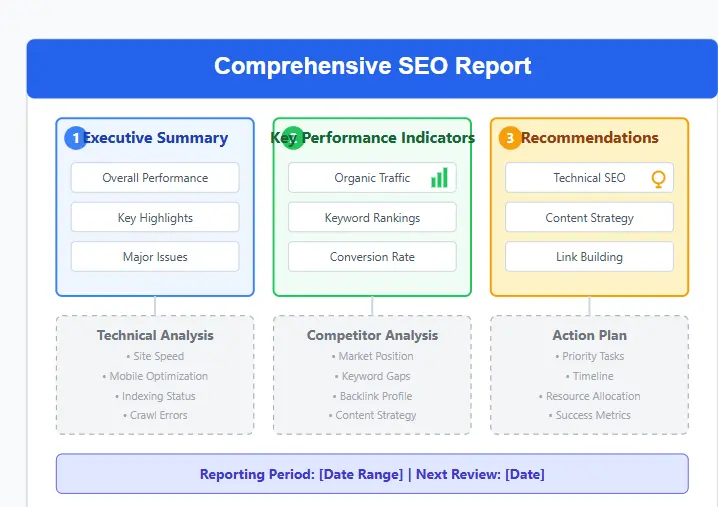
Get Your Free SEO Report Template
Stop wasting time building reports from scratch. Download our professionally designed SEO reporting template that has helped agencies improve client retention by 37%.
Download Free TemplateWeekly SEO Report Template
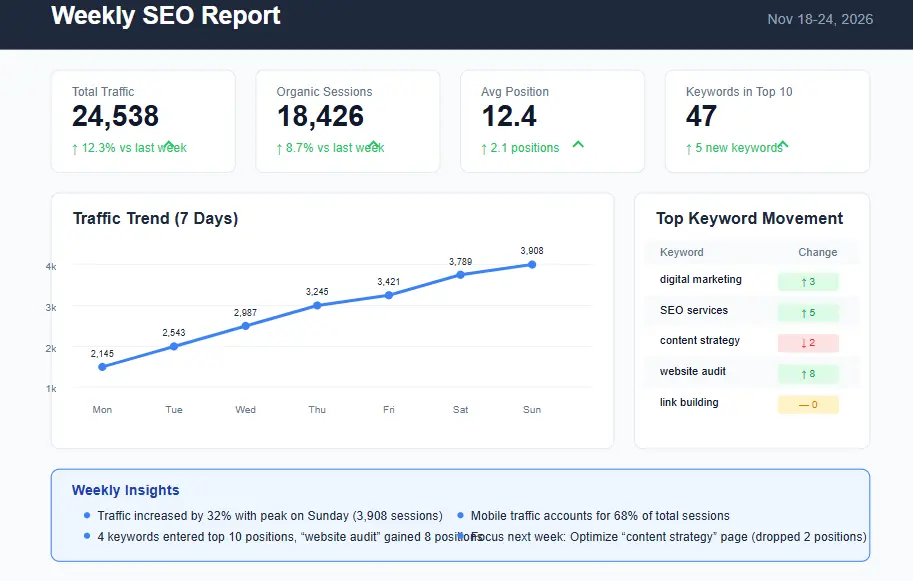
Weekly reporting is ideal for fast-moving campaigns or when working with clients who prefer frequent updates. The best SEO report template for weekly use should be concise and focused on immediate metrics and quick wins. This type of report is typically more operational than strategic, highlighting short-term fluctuations and urgent issues that need attention.
Your weekly SEO reporting template should include:
- Key Metrics Snapshot: Traffic, rankings, and conversions compared to previous week
- Keyword Movement: Significant ranking changes with explanations
- Immediate Issues: Any technical problems or indexing issues discovered
- Content Performance: Top performing pages from the week
- Work Completed: Summary of SEO activities executed this week
- Next Week’s Focus: Priority tasks for the upcoming week
Weekly reports should be visual and scannable, using charts and graphs to highlight trends at a glance. The best SEO report template for weekly use is often just one page long, focusing only on metrics that have shown significant change or require immediate action.
Monthly SEO Report Template
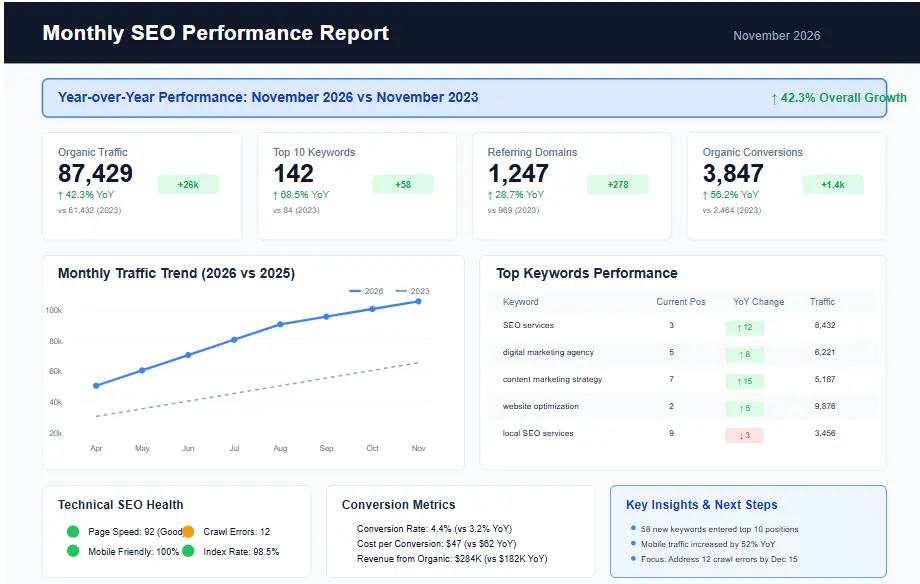
Monthly reporting strikes a balance between providing sufficient detail and avoiding information overload. This is the most common reporting frequency for most SEO agencies and in-house teams. The best SEO report template for monthly use should provide a comprehensive view of performance while beginning to connect activities to outcomes.
Your monthly SEO client report should include:
- Executive Summary: Key achievements and insights from the month
- Goal Progress: Status against monthly objectives
- Traffic Analysis: Organic traffic trends with year-over-year comparisons
- Search Performance: Clicks, impressions, CTR, and position changes
- Keyword Rankings: Movement for target keywords with explanations
- Content Performance: Top pages and content gaps identified
- Technical Health: Issues found and resolved
- Backlink Acquisition: New links earned and authority metrics
- Work Completed: Detailed summary of all SEO activities
- Next Month’s Plan: Prioritized tasks and strategic focus areas
Monthly reports should begin to tell a story about how your SEO efforts are impacting business objectives. The best SEO report template for monthly reporting will connect the dots between activities and outcomes, helping clients understand the value you’re providing.
Quarterly SEO Report Template
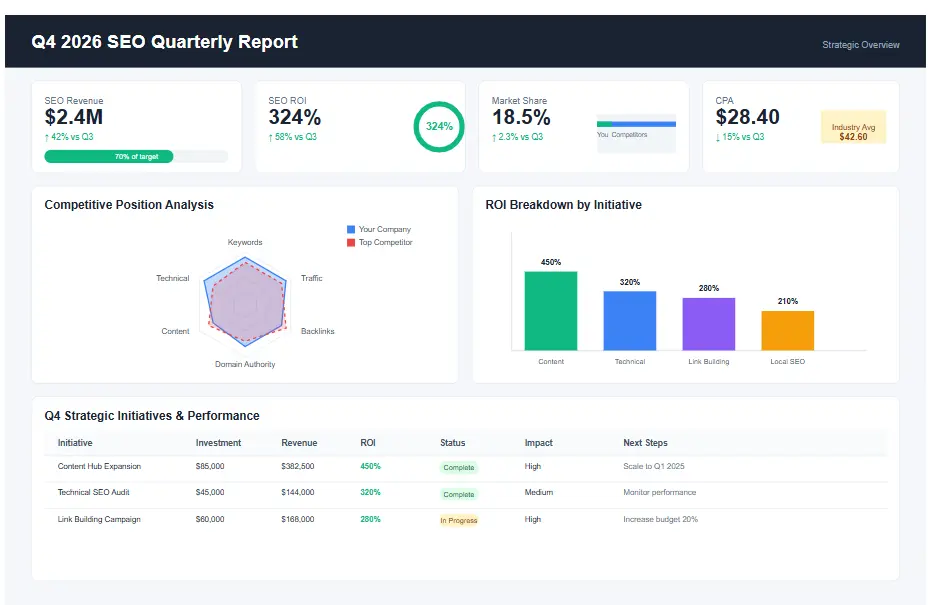
Quarterly reports are more strategic in nature, focusing on longer-term trends and the bigger picture. The best SEO report template for quarterly use should demonstrate how SEO activities are contributing to broader business goals and provide strategic insights for future planning.
Your quarterly SEO reporting template should include:
- Strategic Overview: How SEO is contributing to business objectives
- Quarterly Goal Performance: Achievement against quarterly targets
- Traffic & Conversion Trends: Three-month patterns with year-over-year comparisons
- Market Position: Visibility growth compared to competitors
- Content Performance: Top content pieces and content gaps analysis
- Technical Improvements: Major technical enhancements and their impact
- Authority Building: Backlink acquisition and domain authority growth
- ROI Analysis: Cost per acquisition and return on SEO investment
- Strategic Insights: Key learnings and market opportunities identified
- Next Quarter Strategy: Updated approach based on performance and market changes
Quarterly reports should be more visual and presentation-ready, as they’re often shared with executive stakeholders. The best SEO report template for quarterly use will include competitive analysis and market positioning, helping clients understand how their SEO performance compares to the broader market.
Copy-Paste SEO Report Template
Here’s a comprehensive template you can adapt for your needs. This framework represents the best SEO report template structure that balances detail with readability:
Executive Summary
[Provide a 2-3 paragraph summary of the most important findings and achievements from the reporting period. Highlight key metrics that moved significantly and explain the business impact. This section should be readable in under 60 seconds for busy stakeholders.]
Goals & Status
- Primary Goal: [Main objective for the period]
- Status: [On track/At risk/Achieved]
- Progress: [Specific metrics showing progress toward the goal]
- Secondary Goals: [Other objectives with their status]
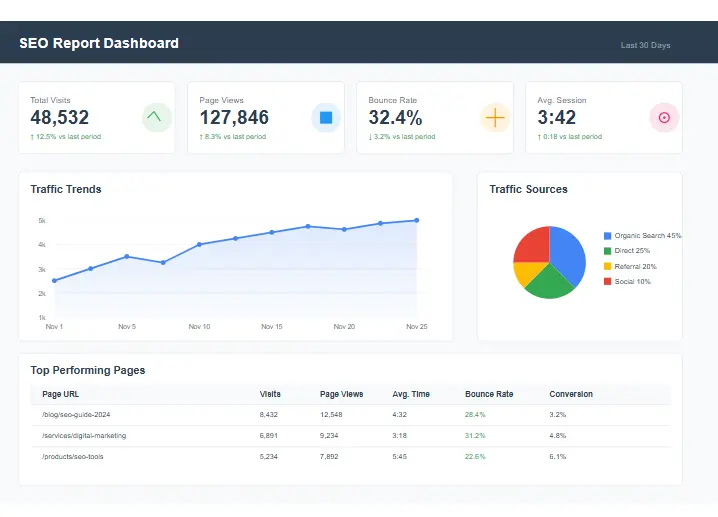
Traffic Overview (GA4)
Organic search brought [number] users this [period], a [percentage] increase/decrease from the previous [period]. This traffic generated [number] conversions at a rate of [percentage], representing [value] in revenue.
Key traffic insights:
- [Most significant traffic trend and explanation]
- [Second notable trend with analysis]
- [Third important observation]
Search Console Performance
Search performance showed [positive/negative] trends across key metrics:
- Clicks: [number] ([percentage] change from previous period)
- Impressions: [number] ([percentage] change from previous period)
- CTR: [percentage] ([percentage] change from previous period)
- Average Position: [number] ([position change from previous period])
Notable changes in search performance include [explanation of significant changes]. For detailed guidance on interpreting these metrics, refer to Google’s Search Console Performance report documentation.
Keyword Movement
Target keyword performance this period:
Top Winners:
- [Keyword] – Moved from position [previous] to [current] (+[number] positions)
- [Keyword] – Moved from position [previous] to [current] (+[number] positions)
- [Keyword] – Moved from position [previous] to [current] (+[number] positions)
Top Losers:
- [Keyword] – Moved from position [previous] to [current] (-[number] positions)
- [Keyword] – Moved from position [previous] to [current] (-[number] positions)
- [Keyword] – Moved from position [previous] to [current] (-[number] positions)
Significant ranking changes were primarily due to [explanation of factors influencing keyword movement].
Top Pages & Content Performance
The following pages drove the most organic traffic this period:
- [Page URL] – [number] sessions ([percentage] of total organic traffic)
- [Page URL] – [number] sessions ([percentage] of total organic traffic)
- [Page URL] – [number] sessions ([percentage] of total organic traffic)
Content performance insights:
- [Notable observation about top performing content]
- [Content gap identified]
- [Content optimization opportunity]
Technical Health Summary
Technical SEO status this period:
- Indexing: [number] pages indexed ([percentage] of submitted pages)
- Core Web Vitals: [percentage] of pages passing all CWV assessments
- Crawl Errors: [number] errors identified and [number] resolved
- Site Speed: Average page load time of [number] seconds ([improvement/decline] from previous period)
Technical issues addressed this period include [summary of technical fixes implemented]. For a comprehensive technical audit, refer to our advanced SEO audit checklist.
Backlinks & Authority Summary
Link acquisition this period:
- New Links: [number] new backlinks acquired
- Referring Domains: [number] new referring domains
- Domain Authority: [current DA] ([change from previous period])
- Notable Links: [highlight 2-3 significant links acquired]
Link building efforts focused on [strategy description], resulting in [outcome].
Local SEO Section (Optional)
Local search performance this period:
- Google Business Profile Views: [number] ([percentage] change)
- Directions Requests: [number] ([percentage] change)
- Phone Calls: [number] ([percentage] change)
- Local Rankings: [summary of position changes in local pack]
Work Completed (This Month)
SEO activities completed this period:
- Technical SEO: [summary of technical work completed]
- Content: [summary of content work completed]
- Link Building: [summary of link building activities]
- Local SEO: [summary of local optimization work]
- Other: [any other significant activities]
Next Month Plan (Priorities)
Priority focus areas for the upcoming period:
- [Priority 1] – [brief description and expected outcome]
- [Priority 2] – [brief description and expected outcome]
- [Priority 3] – [brief description and expected outcome]
Recommendations + Expected Impact
Based on this period’s performance, we recommend the following actions:
- [Recommendation 1] – This is expected to [expected outcome] within [timeframe].
- [Recommendation 2] – This is expected to [expected outcome] within [timeframe].
- [Recommendation 3] – This is expected to [expected outcome] within [timeframe].
Pro Tip: The best SEO report template always connects recommendations directly to business outcomes. Instead of saying “We recommend optimizing title tags,” say “Optimizing title tags for our top 10 pages is projected to increase CTR by 15%, potentially driving an additional [number] monthly visitors based on current impression levels.”
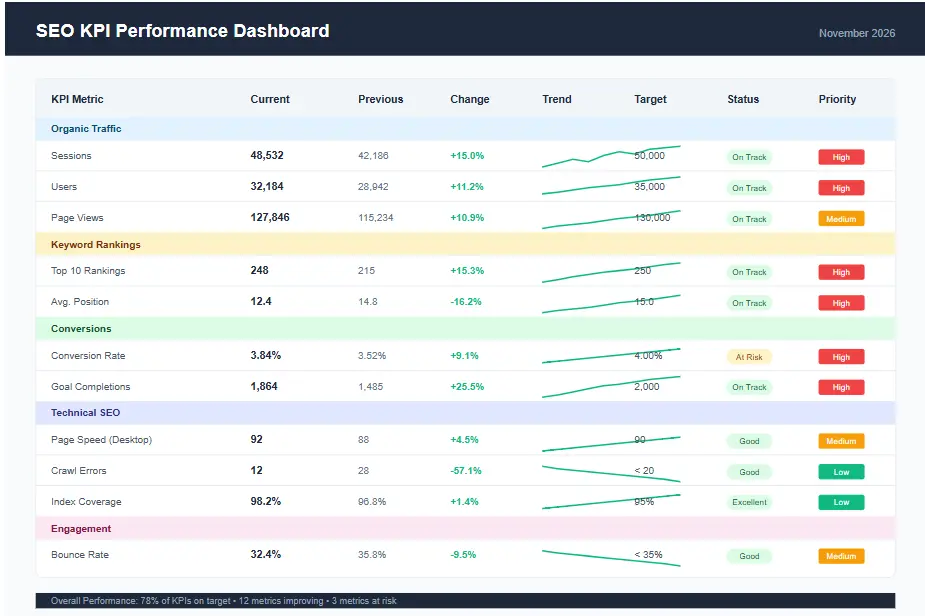
KPI Dashboard Table
Here’s a ready-to-use KPI dashboard table for your SEO reports. This visual format works well in the best SEO report template for quick performance overview:
| Metric | Current Period | Previous Period | Change | Goal | Status |
|---|---|---|---|---|---|
| Organic Traffic | [number] | [number] | [percentage] | [number] | [On track/At risk/Achieved] |
| Organic Conversions | [number] | [number] | [percentage] | [number] | [On track/At risk/Achieved] |
| Keyword Rankings (Top 10) | [number] | [number] | [number] | [number] | [On track/At risk/Achieved] |
| Clicks (Search Console) | [number] | [number] | [percentage] | [number] | [On track/At risk/Achieved] |
| Impressions (Search Console) | [number] | [number] | [percentage] | [number] | [On track/At risk/Achieved] |
| CTR | [percentage] | [percentage] | [percentage points] | [percentage] | [On track/At risk/Achieved] |
| Backlinks Acquired | [number] | [number] | [number] | [number] | [On track/At risk/Achieved] |
| Domain Authority | [number] | [number] | [+/- number] | [number] | [On track/At risk/Achieved] |
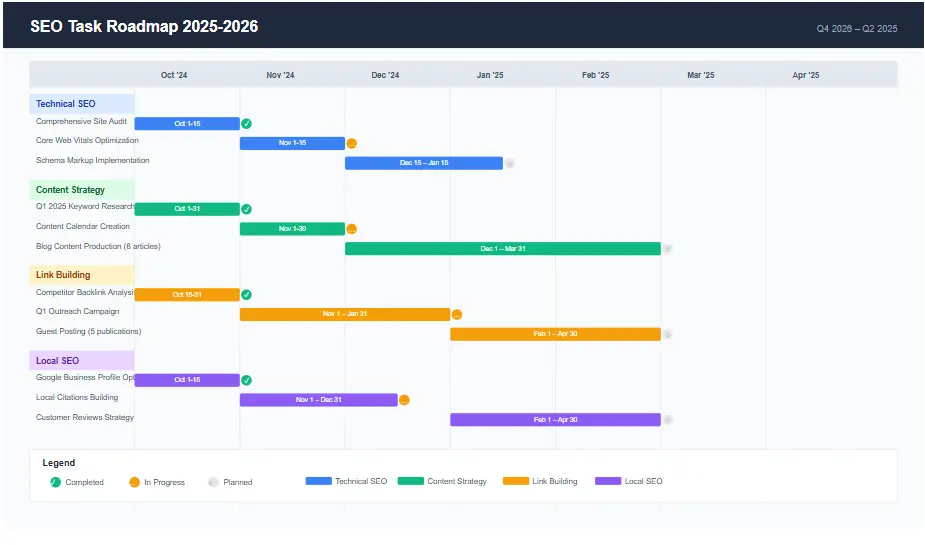
Task/Roadmap Table
Use this task roadmap table to clearly communicate upcoming work and priorities. This is an essential component of the best SEO report template for setting expectations:
| Task | Priority | Expected Impact | Timeline | Status |
|---|---|---|---|---|
| [Task description] | High/Medium/Low | [Expected outcome] | [Start date] – [End date] | Not started/In progress/Completed |
| [Task description] | High/Medium/Low | [Expected outcome] | [Start date] – [End date] | Not started/In progress/Completed |
| [Task description] | High/Medium/Low | [Expected outcome] | [Start date] – [End date] | Not started/In progress/Completed |
| [Task description] | High/Medium/Low | [Expected outcome] | [Start date] – [End date] | Not started/In progress/Completed |
| [Task description] | High/Medium/Low | [Expected outcome] | [Start date] – [End date] | Not started/In progress/Completed |
How to Present an SEO Report to Clients
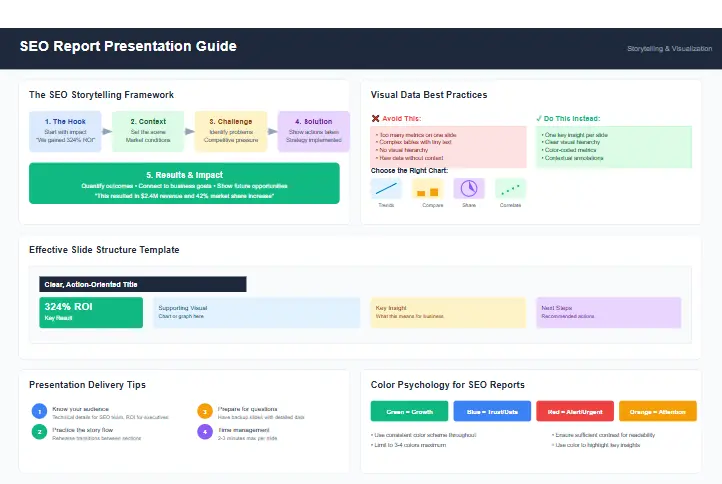
Creating the best SEO report template is only half the battle—how you present that data can make or break client relationships. Here are proven strategies for presenting SEO reports effectively:
Focus on Storytelling, Not Just Data
The most effective SEO reports tell a story that connects your activities to business outcomes. Instead of simply presenting metrics, frame them within a narrative that shows progress toward client goals. For example:
“Our focus on optimizing product category pages this month resulted in a 27% increase in organic traffic to these key conversion pages, directly contributing to an estimated $15,000 in additional revenue based on average conversion values.”
This approach transforms data into a compelling narrative that demonstrates value and justifies your SEO investment.
Use Visuals to Highlight Key Points
Visual elements make your reports more digestible and memorable. The best SEO report template incorporates charts, graphs, and annotations to draw attention to important trends and insights. Consider these visualization tips:
- Use line charts for trends over time
- Employ bar charts for comparisons
- Create annotated screenshots to highlight specific improvements
- Use heat maps to show user behavior patterns
- Incorporate before/after comparisons for technical fixes
Customize for Your Audience
Different stakeholders care about different metrics. The best SEO report template should be adaptable based on who’s reviewing it:
- For C-level executives: Focus on business impact, ROI, and competitive positioning
- For marketing managers: Include channel comparisons and lead quality metrics
- For technical teams: Provide detailed technical diagnostics and implementation notes
Prepare for Questions
Anticipate questions your client might ask and prepare answers in advance. Common questions include:
- Why did traffic drop on [specific date]?
- How are we performing against competitors?
- What would happen if we increased our SEO budget?
- When can we expect to see results from [recent activity]?
Follow Up with Actionable Next Steps
End your presentation with clear next steps and timelines. The best SEO report template always includes a forward-looking component that shows continued value and sets expectations for the next reporting period.
Pro Tip: Schedule a 30-minute call to walk through your report with clients. This personal touch helps ensure they understand the value you’re providing and provides an opportunity to address questions in real-time. For additional reporting guidance, check out Google’s SEO Starter Guide.
Frequently Asked Questions
How often should I send SEO reports to clients?
The frequency depends on your client’s preferences and the nature of your SEO campaign. Weekly reports work best for new campaigns or when implementing significant changes. Monthly reports are standard for most ongoing SEO relationships. Quarterly reports are ideal for strategic reviews with executive stakeholders. The best SEO report template can be adapted for any frequency.
What tools can I use to automate SEO reporting?
Several tools can streamline your reporting process. Google Data Studio allows you to create customizable dashboards that pull data from Google Analytics and Search Console. AgencyAnalytics, Reportei, and Whatagraph offer specialized SEO reporting features. For a more hands-on approach, Google Sheets with add-ons like Supermetrics provides flexibility at a lower cost. The best SEO report template can be implemented in any of these platforms.
How do I explain algorithm updates in my SEO report?
When algorithm updates affect your rankings, include a dedicated section in your report explaining the update, its known impact, and your response strategy. Show before/after metrics to illustrate the impact, and outline specific actions you’re taking to adapt. The best SEO report template will always contextualize performance changes within the broader search landscape.
Should I include competitor rankings in my SEO report?
Yes, including competitor data provides valuable context for your performance. Show visibility trends for 2-3 key competitors, highlighting where you’re gaining or losing ground. However, keep competitor analysis focused on the most relevant competitors and metrics that align with your client’s business objectives. The best SEO report template balances competitive insights with a focus on your own progress.
How do I report on local SEO performance?
Local SEO reports should include Google Business Profile metrics (views, clicks, calls, direction requests), local keyword rankings, local pack performance, and customer review metrics. Include screenshots of local SERP features and track performance across different geographic locations if relevant to your client’s business. The best SEO report template for local businesses will emphasize these location-specific metrics.
What’s the best way to show ROI from SEO activities?
To demonstrate ROI, connect SEO metrics to revenue or lead values. Track organic conversions and assign values based on average customer worth or lead value. Show cost-per-acquisition compared to other channels. For non-eCommerce sites, use lead quality metrics or estimated revenue based on conversion rates. The best SEO report template always ties activities to business outcomes.
How detailed should technical SEO reports be?
The level of technical detail should match your audience’s technical knowledge. For technical stakeholders, include detailed diagnostics, crawl stats, and specific error resolutions. For non-technical audiences, summarize technical issues in business terms (e.g., “Fixed 5 critical errors that were preventing 200 pages from being indexed, potentially unlocking 3,000 monthly visits”). The best SEO report template adapts technical content to the audience.
Should I include traffic projections in SEO reports?
Yes, but with appropriate caveats. Include realistic projections based on historical data and seasonal trends. Clearly state assumptions and potential variables that could affect outcomes. Show both conservative and optimistic scenarios. The best SEO report template uses projections to set expectations while maintaining credibility by acknowledging uncertainties.
How do I handle reporting during periods of algorithm volatility?
During algorithm updates or periods of unusual volatility, provide additional context in your reports. Include a section explaining the situation, showing industry-wide impact if available, and outlining your strategic response. Maintain transparency about factors outside your control while emphasizing proactive measures you’re taking. The best SEO report template builds trust through honest communication during challenging periods.
What’s the best format for delivering SEO reports?
The format depends on client preference. PDF reports work well for formal monthly reviews. Interactive dashboards (Google Data Studio, etc.) are ideal for clients who want real-time access to data. PowerPoint presentations work best for in-person meetings. The best SEO report template can be adapted to multiple formats while maintaining consistent messaging and metrics.
Conclusion: Your Path to Better SEO Reporting
Creating effective SEO reports is about more than just presenting data—it’s about demonstrating value, building trust, and guiding strategic decisions. The best SEO report template transforms complex metrics into clear insights that drive action and reinforce the value of your SEO efforts.
Remember that reporting should be a conversation, not a monologue. Use these templates as starting points, but always customize based on your client’s specific goals, industry, and level of SEO knowledge. The most successful SEO professionals adapt their reporting approach to each client relationship while maintaining consistent measurement of key performance indicators.
Ready to elevate your SEO reporting game? Download our free SEO report template to get started with a proven framework that has helped agencies improve client retention and demonstrate value more effectively.
For additional SEO resources, check out our free keyword research template and internal linking template to expand your SEO toolkit beyond reporting.