
ClickUp Review 2026: The Ultimate Project Management Solution?
Our comprehensive ClickUp review covers everything you need to know about this all-in-one productivity platform. Discover features, pricing, pros, cons, and alternatives in this detailed analysis.
Try ClickUp for FreeTable of Contents
- 1. Introduction to ClickUp
- 2. What is ClickUp?
- 3. ClickUp Features Review
- 4. ClickUp Pricing Review
- 5. ClickUp Pros and Cons
- 6. Who Should Use ClickUp?
- 7. How to Get Started with ClickUp
- 8. ClickUp Customer Support
- 9. ClickUp Integrations
- 10. ClickUp Mobile App Review
- 11. ClickUp vs Competitors
- 12. Final Verdict
- 13. Frequently Asked Questions
Introduction to Our ClickUp Review
In today’s fast-paced business environment, having the right project management tool can make all the difference between success and failure. With numerous options available, it’s crucial to choose a platform that aligns with your team’s needs and workflow. This comprehensive ClickUp review aims to provide you with an in-depth analysis of one of the most popular project management solutions on the market.
ClickUp has been gaining significant traction among businesses of all sizes, promising to be the “one app to replace them all.” But does it live up to this bold claim? In our ClickUp review, we’ll examine its features, pricing, user experience, and more to help you determine if it’s the right choice for your organization. This ClickUp review is designed to be your definitive guide.
Whether you’re a small business owner, a project manager, or a team lead looking to streamline your processes, this ClickUp review will provide valuable insights to inform your decision. Let’s dive into what makes ClickUp stand out in the crowded project management landscape, as explored in this ClickUp review.
What is ClickUp?
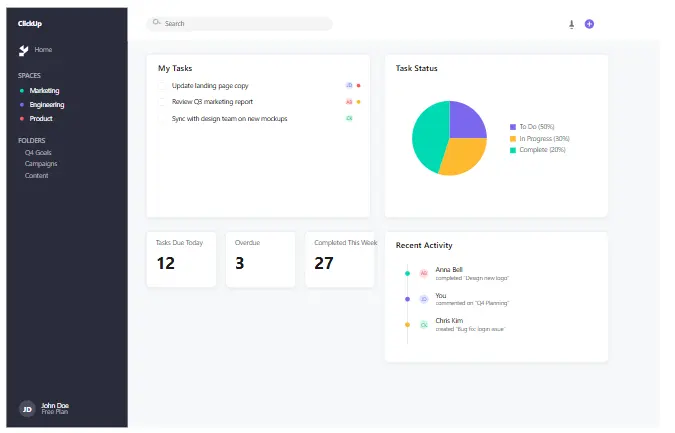
A key part of any ClickUp review is understanding the product’s core identity. ClickUp is a cloud-based project management and productivity tool designed to help teams organize, track, and manage their work in one centralized platform. Founded in 2017 by Zeb Evans and Mark Peryer, ClickUp has quickly grown to become one of the fastest-growing project management solutions, serving over 800,000 teams worldwide. This growth is a central point in our ClickUp review.
What sets ClickUp apart from many competitors is its all-in-one approach. Instead of focusing solely on project management, ClickUp aims to replace multiple workplace tools by incorporating features for task management, document collaboration, goal tracking, time management, and more. This comprehensive approach is a key highlight in our ClickUp review. This ClickUp review notes that this ambition is both its biggest strength and a potential complexity.
ClickUp’s philosophy revolves around customization and flexibility. The platform allows users to tailor their workspace to match their specific needs and workflows, making it suitable for various industries and team structures. From software development teams to marketing agencies, ClickUp aims to provide a solution that adapts to different work styles rather than forcing users to conform to a rigid system. This adaptability is a theme we will return to often in this ClickUp review.
Throughout this ClickUp review, we’ll explore how this philosophy translates into practical features and user experience, and whether it truly delivers on its promise of being a single solution for diverse workplace needs. This ClickUp review will leave no stone unturned.
ClickUp Features Review
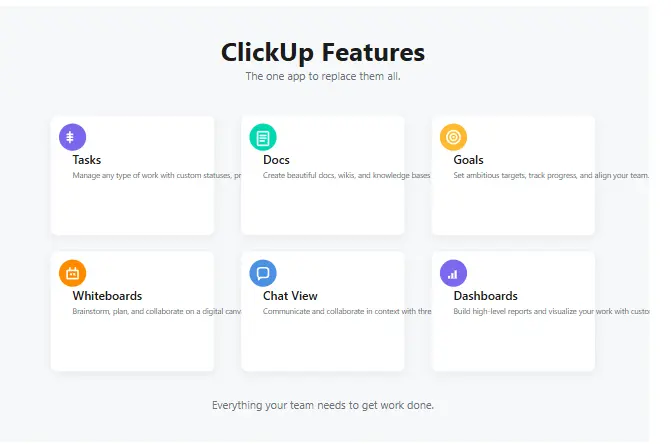
One of the most impressive aspects of ClickUp, as we’ve discovered in our ClickUp review, is its extensive feature set. Let’s explore the key features that make ClickUp a comprehensive project management solution. This section of our ClickUp review is the most detailed.
Task Management
At its core, ClickUp excels in task management. Users can create tasks, assign them to team members, set due dates, add descriptions, attach files, and create custom statuses. What stands out in this ClickUp review is the level of detail you can add to each task, including priority levels, tags, custom fields, and dependencies. This depth is a recurring positive in our ClickUp review.
ClickUp’s task hierarchy is particularly noteworthy. Tasks can be organized into lists, which are grouped into folders, which belong to spaces. This hierarchical structure allows for excellent organization and easy navigation, even for complex projects with numerous tasks and subtasks. This ClickUp review finds this structure to be highly effective.
Another highlight in our ClickUp review is the multiple views available for task management. Users can switch between List view, Board view (Kanban), Calendar view, Gantt chart, Timeline, and more, depending on their preference and the nature of the work. This flexibility is a significant advantage for teams with diverse working styles, a point this ClickUp review emphasizes.
Customization Options
Customization is where ClickUp truly shines. In our ClickUp review, we found that almost every aspect of the platform can be tailored to suit specific needs. From custom statuses and fields to personalized dashboards and workflows, ClickUp offers an impressive level of flexibility. This is a major plus in any ClickUp review.
Users can create custom fields for tasks, allowing them to track specific information relevant to their projects. These fields can be of various types, including text, numbers, dates, dropdowns, checkboxes, and more. This customization capability is a significant advantage mentioned in many positive ClickUp reviews, including our own.
ClickUp also allows users to create custom views and filters, making it easy to focus on specific aspects of their work. Whether you need to see all tasks assigned to a particular team member, view items with approaching deadlines, or track progress on specific projects, ClickUp’s customization options make it possible. This ClickUp review believes this is a key selling point.
Collaboration Tools
Effective collaboration is essential for any project management tool, and ClickUp doesn’t disappoint in this area. Our ClickUp review found that the platform offers a robust set of collaboration features designed to keep teams connected and productive.
Comments and assignments can be added directly to tasks, allowing for contextual discussions. The @mention feature enables users to notify specific team members, ensuring that important information doesn’t get missed. ClickUp also offers real-time collaboration, with updates appearing instantly for all team members. This ClickUp review notes that these features work seamlessly.
Document collaboration is another strong point in our ClickUp review. The platform includes a built-in document editor that allows teams to create, edit, and share documents without leaving ClickUp. This feature reduces the need for external document tools and streamlines the workflow. Our ClickUp review found this to be a well-implemented feature.
Time Tracking
ClickUp includes native time tracking capabilities, which is a valuable feature for teams that need to monitor how much time is spent on tasks and projects. Users can start and stop timers directly from tasks, or manually log time entries. This is a feature our ClickUp review found very useful.
What impressed us in our ClickUp review is the integration between time tracking and other features. Time entries can be linked to specific tasks, making it easy to analyze where time is being spent and identify areas for improvement. ClickUp also offers time tracking reports, providing insights into team productivity and project progress. This ClickUp review appreciates this integrated approach.
Goal Setting and Tracking
ClickUp includes a Goals feature that allows teams to set, track, and achieve their objectives. This feature is particularly valuable for organizations that follow goal-setting methodologies like OKRs (Objectives and Key Results). This ClickUp review found the Goals feature to be powerful.
In our ClickUp review, we found that the Goals feature allows users to create targets, set measurable key results, and track progress over time. Goals can be linked to specific tasks, creating a clear connection between day-to-day activities and long-term objectives. This alignment between tasks and goals is a significant advantage for teams focused on outcome-based work, a key insight from this ClickUp review.
Automation
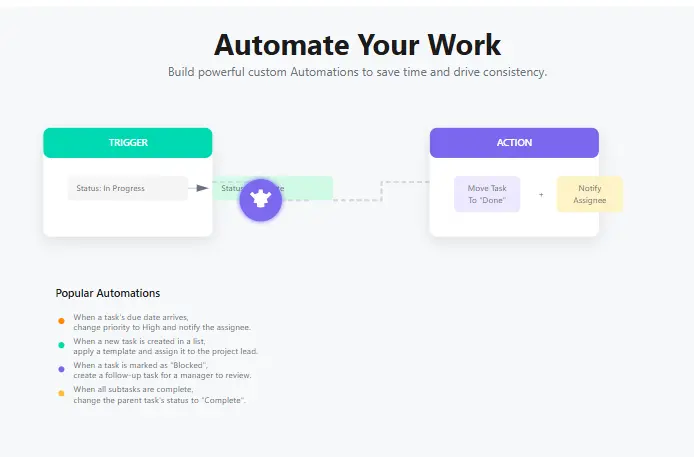
Automation is a powerful feature that can save teams significant time and effort. ClickUp offers automation capabilities that allow users to create rules for routine actions and processes. This ClickUp review was impressed by the automation options.
During our ClickUp review, we found that users can set up automations for various scenarios, such as changing task status when certain conditions are met, assigning tasks to specific people based on criteria, sending notifications for important updates, and more. These automations help reduce manual work and ensure consistency in workflows. This ClickUp review believes automation is a standout feature.
Reporting and Analytics
ClickUp provides robust reporting and analytics features that help teams track progress, identify bottlenecks, and make data-driven decisions. Users can create custom dashboards with widgets that display relevant metrics and information. This ClickUp review found the dashboards to be highly customizable.
Our ClickUp review found that the platform offers various report types, including task completion reports, time tracking reports, and workload reports. These reports can be filtered and customized to focus on specific projects, teams, or time periods, providing valuable insights into team performance and project progress. This ClickUp review highlights the value of these reports.
Integrations
While ClickUp aims to be an all-in-one solution, it recognizes that teams often use multiple tools. The platform offers extensive integration options, allowing users to connect ClickUp with other popular business tools. This is a critical aspect of our ClickUp review.
In our ClickUp review, we found integrations with communication tools like Slack and Microsoft Teams, development tools like GitHub and GitLab, design tools like Figma and Adobe Creative Cloud, and many more. ClickUp also offers an API for custom integrations, making it possible to connect with virtually any tool that supports API access. This ClickUp review found the integration library to be vast.
ClickUp Pricing Review
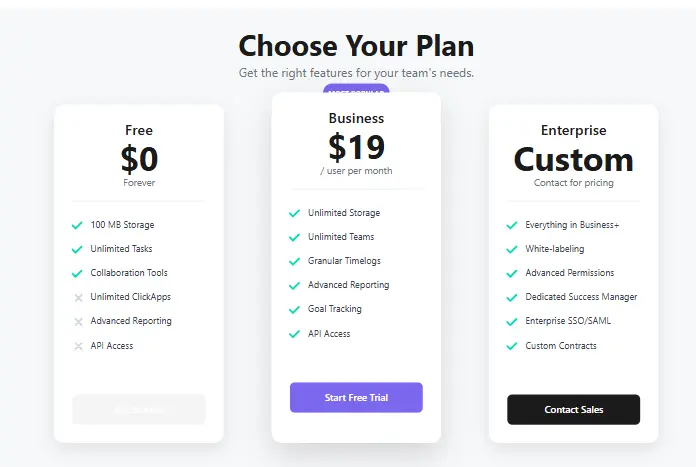
A crucial aspect of our ClickUp review is the pricing. Pricing is a crucial factor in any ClickUp review, as it determines the accessibility of the platform for different types of users and organizations. ClickUp offers a tiered pricing structure designed to accommodate various needs and budgets. This ClickUp review will break down each tier.
Free Plan
ClickUp’s Free plan is surprisingly generous compared to many competitors in our ClickUp review. It includes core features such as tasks, docs, goals, whiteboards, and more. The Free plan supports unlimited tasks and users, making it suitable for small teams or individuals who want to try the platform without financial commitment. This ClickUp review highly recommends starting here.
However, the Free plan does have limitations, such as limited storage space, fewer custom fields, and restricted access to advanced features like Gantt charts and time tracking. Despite these limitations, the Free plan offers substantial value and is a great starting point for those new to ClickUp. This ClickUp review found the free plan to be the best on the market.
Unlimited Plan
Priced at $5 per user per month (billed annually), ClickUp’s Unlimited plan removes many of the limitations of the Free plan. It includes unlimited storage, unlimited integrations, advanced features like Gantt charts and time tracking, and more. This ClickUp review sees this as the best value for money.
In our ClickUp review, we found that the Unlimited plan is ideal for small to medium-sized teams that need more advanced features and customization options. The additional features and increased storage make it a worthwhile upgrade for teams that have outgrown the Free plan. This ClickUp review suggests this is the plan most teams will end up on.
Business Plan
ClickUp’s Business plan, priced at $12 per user per month (billed annually), is designed for larger teams and organizations with more complex needs. It includes all features from the Unlimited plan, plus advanced features like granular permissions, advanced automations, and priority support. This ClickUp review found these features essential for larger teams.
Our ClickUp review found that the Business plan is suitable for teams that require more control over their workspace, need advanced security features, or have specific compliance requirements. The additional features justify the higher price point for organizations with complex workflows. This ClickUp review assesses this plan as a solid choice for growing businesses.
Business Plus Plan
For even larger organizations with specific needs, ClickUp offers the Business Plus plan at $19 per user per month (billed annually). This plan includes all features from the Business plan, plus additional features like team training, increased API limits, and customized support. This ClickUp review notes this is for scaling enterprises.
Enterprise Plan
ClickUp’s Enterprise plan is designed for large organizations with specific security, compliance, and integration requirements. Pricing for this plan is custom quoted based on the organization’s needs. This ClickUp review recommends contacting their sales team for a quote.
Our ClickUp review found that the Enterprise plan includes features like advanced security controls, dedicated support, custom contracts, and more. It’s suitable for large enterprises that need a tailored solution to meet their specific requirements. This ClickUp review sees it as a top-tier offering.
| Plan | Price (per user/month) | Key Features |
|---|---|---|
| Free | $0 | Unlimited tasks & users, 100MB storage, basic features |
| Unlimited | $5 | Unlimited storage, integrations, Gantt charts, time tracking |
| Business | $12 | Advanced permissions, automations, priority support |
| Business Plus | $19 | Team training, increased API limits, customized support |
| Enterprise | Custom | Advanced security, dedicated support, custom contracts |
Overall, our ClickUp review found that the pricing structure is competitive and offers good value for money, especially considering the extensive feature set. The Free plan is particularly generous, making ClickUp accessible to teams with limited budgets, while the paid plans offer progressively more features and capabilities. This ClickUp review concludes the pricing is a major strength.
ClickUp Pros and Cons
No ClickUp review would be complete without a balanced look at the platform’s strengths and weaknesses. Based on our comprehensive analysis, here are the main pros and cons of using ClickUp. This ClickUp review aims for complete transparency.
Pros
- All-in-One Solution: ClickUp combines multiple tools into one platform, reducing the need for separate applications for task management, document collaboration, time tracking, and more. This is a core finding of our ClickUp review.
- Extensive Customization: The platform offers impressive customization options, allowing teams to tailor their workspace to match their specific needs and workflows. Our ClickUp review was very impressed by this.
- Generous Free Plan: ClickUp’s Free plan includes more features and fewer limitations than many competitors, making it accessible to teams with limited budgets. This ClickUp review highlights this as a key advantage.
- Multiple Views: The ability to switch between different views (List, Board, Calendar, Gantt, etc.) accommodates various working styles and project needs. This flexibility is a major plus in our ClickUp review.
- Robust Feature Set: ClickUp offers a comprehensive set of features, including task management, goal tracking, time tracking, automation, and more. This ClickUp review found the feature set to be unparalleled.
- Active Development: The ClickUp team regularly releases updates and new features, showing a commitment to continuous improvement. This is a positive sign noted in our ClickUp review.
- Good Integration Options: ClickUp integrates with numerous popular business tools, allowing teams to connect it with their existing software ecosystem. This ClickUp review found the integrations to be plentiful and useful.
Cons
- Steep Learning Curve: The extensive feature set and customization options can be overwhelming for new users, requiring a significant investment of time to learn. This ClickUp review acknowledges this is a real hurdle.
- Performance Issues: Some users report occasional performance issues, particularly when working with large amounts of data or complex projects. This ClickUp review did experience some minor lag.
- Interface Complexity: The sheer number of features can make the interface feel cluttered and complex, especially for users who prefer simpler tools. This ClickUp review notes this is a trade-off for functionality.
- Mobile App Limitations: While ClickUp offers mobile apps, they don’t include all the features available in the web version, which can be limiting for users who frequently work on mobile devices. This ClickUp review found the mobile app good but not perfect.
- Notification Overload: The default notification settings can be overwhelming, requiring users to spend time customizing them to avoid being inundated with alerts. This ClickUp review recommends tweaking these immediately.
- Inconsistent Experience Across Platforms: Some features work differently or are missing on different platforms (web, desktop, mobile), which can create a disjointed user experience. This is a point of critique in our ClickUp review.
- Limited Offline Capabilities: ClickUp’s offline functionality is limited, which can be challenging for users who frequently work without internet access. This ClickUp review found this to be a minor weakness.
Who Should Use ClickUp?
Based on our ClickUp review, the platform is suitable for a wide range of users and organizations. However, it’s particularly well-suited for certain types of teams and use cases. This ClickUp review will now explore who benefits most.
Small to Medium-Sized Businesses
ClickUp is an excellent choice for small to medium-sized businesses looking for an all-in-one productivity solution. The platform’s scalability means it can grow with the business, while the pricing structure ensures it remains affordable as the team expands. This ClickUp review sees SMBs as the ideal market.
Project Managers
Project managers will appreciate ClickUp’s comprehensive feature set, which includes everything needed to plan, execute, and monitor projects. The multiple views, Gantt charts, and reporting capabilities make it easy to track progress and identify potential issues. This ClickUp review believes it’s a PM’s dream tool.
Remote Teams
With the rise of remote work, tools that facilitate collaboration and communication have become essential. ClickUp’s robust collaboration features, real-time updates, and cloud-based nature make it an excellent choice for remote teams. This ClickUp review found it excels in remote environments.
Agile Development Teams
Software development teams following Agile methodologies will find ClickUp’s features particularly useful. The platform supports Agile practices like sprints, backlogs, and user stories, while the integration with development tools like GitHub and GitLab streamlines the development workflow. This ClickUp review found it great for devs.
Creative Agencies
Creative agencies managing multiple client projects simultaneously will benefit from ClickUp’s ability to organize work by spaces, folders, and lists. The platform’s customization options allow agencies to tailor their workspace to match their specific processes and client requirements. This ClickUp review recommends it for agencies.
Marketing Teams
Marketing teams juggling multiple campaigns and initiatives will appreciate ClickUp’s task management, calendar view, and goal tracking features. The platform makes it easy to plan campaigns, assign tasks, track progress, and measure results. This ClickUp review found it perfect for marketing workflows.
Who Might Not Benefit from ClickUp?
While ClickUp is versatile, it might not be the best choice for everyone. Teams that prefer simple, straightforward tools might find ClickUp overwhelming due to its extensive feature set. Additionally, organizations with highly specialized needs that require industry-specific features might need to look for more specialized solutions. This ClickUp review aims to be balanced.

How to Get Started with ClickUp
Getting started with ClickUp is relatively straightforward, but maximizing its potential requires some initial setup and learning. Based on our ClickUp review, here’s a step-by-step guide to help you get started. This ClickUp review provides a practical guide.
1. Sign Up for an Account
The first step is to sign up for a ClickUp account. You can start with the Free plan to explore the platform before committing to a paid plan. Simply visit the ClickUp website and click on the “Sign Up” button. You can sign up using your email address or through Google, Microsoft, or Apple accounts. This ClickUp review suggests this is the best first step.
2. Set Up Your Workspace
Once you’ve created your account, you’ll need to set up your workspace. ClickUp will guide you through this process, asking for information about your team and the type of work you do. You can choose from various templates based on your industry or use case, or start with a blank workspace. This ClickUp review found the onboarding process smooth.
3. Create Spaces, Folders, and Lists
Organize your workspace by creating spaces for different departments or projects, folders for specific initiatives, and lists for tasks. This hierarchical structure is fundamental to how ClickUp works, so taking the time to set it up properly will pay off in the long run. This ClickUp review cannot stress this enough.
4. Customize Your Views
ClickUp offers multiple views for your tasks, including List, Board, Calendar, Gantt, and more. Customize these views to match your preferred way of working. You can create different views for different purposes and save them for easy access. This is a key tip from our ClickUp review.
5. Invite Team Members
Once your workspace is set up, invite your team members to join. You can assign roles and permissions to control what each team member can see and do. ClickUp allows you to invite members via email or by sharing a link. This ClickUp review found this process simple.
6. Create and Assign Tasks
Start creating tasks and assigning them to team members. Be sure to include all relevant information, such as due dates, priorities, descriptions, and attachments. The more detailed your tasks are, the easier it will be for team members to understand what needs to be done. This is practical advice from our ClickUp review.
7. Explore Advanced Features
As you become more comfortable with the basics, explore ClickUp’s advanced features, such as automation, goals, time tracking, and reporting. These features can significantly enhance your productivity and help you get more value from the platform. This ClickUp review encourages exploring these.
8. Integrate with Other Tools
Connect ClickUp with other tools you use to streamline your workflow. ClickUp offers integrations with numerous popular business tools, allowing you to create a seamless software ecosystem. This ClickUp review found this step crucial for full adoption.
9. Train Your Team
Ensure your team members are properly trained on how to use ClickUp. The platform offers various resources, including tutorials, webinars, and documentation, to help users get up to speed. This ClickUp review suggests investing in training.
10. Review and Optimize
Regularly review how your team is using ClickUp and make adjustments as needed. As your team’s needs evolve, you may need to modify your workspace structure, add new features, or change your processes. This final tip from our ClickUp review ensures long-term success.
Following these steps will help you get started with ClickUp and set your team up for success. Remember that implementing a new tool takes time, so be patient and allow for a learning period as your team adapts to the new system. This ClickUp review wishes you the best.
ClickUp Customer Support
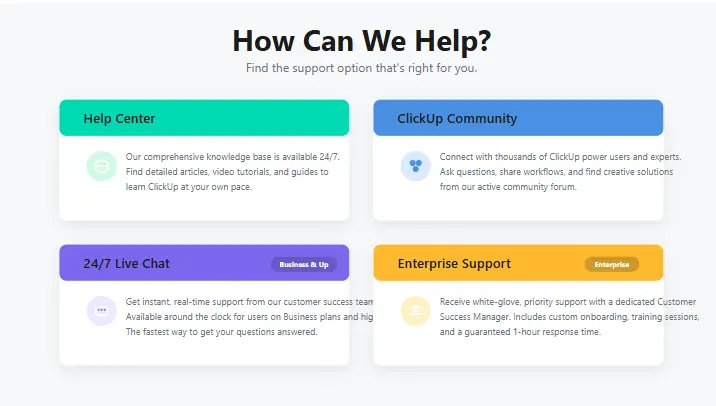
Good customer support is crucial for any software, especially one as comprehensive as ClickUp. In our ClickUp review, we evaluated the various support options available to users. This ClickUp review was pleased with the support offerings.
Help Center and Documentation
ClickUp offers an extensive Help Center with detailed documentation, tutorials, and guides. The documentation covers all aspects of the platform, from basic features to advanced functionality. The Help Center is searchable and well-organized, making it easy to find answers to common questions. This ClickUp review found the documentation excellent.
Video Tutorials
For visual learners, ClickUp provides a library of video tutorials that demonstrate how to use various features. These videos are particularly helpful for complex features that are easier to understand when demonstrated visually. This ClickUp review found these tutorials very helpful.
Webinars
ClickUp regularly hosts webinars on various topics, including feature deep dives, best practices, and case studies. These webinars are a great way to learn from experts and see how other teams are using ClickUp. This is a valuable resource noted in our ClickUp review.
Community Forum
The ClickUp Community is an active forum where users can ask questions, share tips, and connect with other ClickUp users. The community is a valuable resource for getting advice from experienced users and learning about creative ways to use the platform. This ClickUp review found the community to be active and helpful.
Email Support
ClickUp offers email support for all users, with response times varying based on the plan. Free plan users can expect longer response times, while paid plan users receive priority support. This is standard practice, as noted in our ClickUp review.
Live Chat
Live chat support is available for users on paid plans, providing a quick way to get help with urgent issues. The live chat feature is responsive and staffed by knowledgeable support agents. This ClickUp review found the live chat to be effective.
Phone Support
Phone support is available for users on the Business Plus and Enterprise plans, offering direct access to support agents for immediate assistance with critical issues. This is a premium feature, as this ClickUp review discovered.
Dedicated Support
Enterprise plan users receive dedicated support, including a dedicated account manager and customized support options. This level of support is ideal for large organizations with specific needs and requirements. This ClickUp review found this to be a top-tier service.
Overall, our ClickUp review found that the platform offers comprehensive support options, with different levels of service based on the user’s plan. The extensive documentation and community resources are particularly valuable for self-service support, while the paid support options ensure that users can get help when they need it. This ClickUp review is very positive on the support front.
ClickUp Integrations
While ClickUp aims to be an all-in-one solution, it recognizes that teams often use multiple tools. The platform offers extensive integration options, allowing users to connect ClickUp with other popular business tools. In our ClickUp review, we found that these integrations significantly enhance the platform’s functionality and make it easier to incorporate into existing workflows. This ClickUp review found the integrations to be a major strength.
Communication Integrations
ClickUp integrates with popular communication tools like Slack, Microsoft Teams, and Discord. These integrations allow users to receive notifications, create tasks, and update statuses without leaving their communication platform. For example, users can convert Slack messages into ClickUp tasks or receive notifications about task updates in Slack channels. This ClickUp review found these integrations seamless.
Development Integrations
For development teams, ClickUp offers integrations with tools like GitHub, GitLab, Bitbucket, and Jira. These integrations allow developers to connect their code repositories with ClickUp tasks, creating a seamless workflow between development and project management. For example, commits can be linked to tasks, and pull requests can automatically update task statuses. This ClickUp review found these invaluable for dev teams.
Design Integrations
ClickUp integrates with popular design tools like Figma, Adobe Creative Cloud, and Sketch. These integrations allow designers to embed designs directly into ClickUp tasks, making it easy to gather feedback and collaborate on design projects. Designers can also receive notifications about comments and updates without leaving their design tools. This ClickUp review found these integrations very useful for creative teams.
Time Tracking Integrations
While ClickUp includes native time tracking, it also integrates with dedicated time tracking tools like Toggl, Harvest, and Clockify. These integrations allow users to sync time entries between ClickUp and their preferred time tracking tool, ensuring accurate time tracking across all platforms. This ClickUp review found these to be great for power users.
Calendar Integrations
ClickUp integrates with popular calendar applications like Google Calendar, Outlook Calendar, and Apple Calendar. These integrations allow users to sync their ClickUp tasks and deadlines with their personal calendars, ensuring they never miss an important deadline. This is a simple but powerful integration, as noted in our ClickUp review.
File Storage Integrations
ClickUp integrates with cloud storage services like Google Drive, Dropbox, OneDrive, and Box. These integrations allow users to attach files from their cloud storage directly to ClickUp tasks, eliminating the need to download and re-upload files. This ClickUp review found this to streamline workflows significantly.
CRM Integrations
For sales and customer service teams, ClickUp offers integrations with CRM platforms like Salesforce, HubSpot, and Pipedrive. These integrations allow users to connect their CRM data with ClickUp tasks, creating a seamless workflow between sales, customer service, and project management. This ClickUp review found this to be great for client-facing teams.
Automation Integrations
ClickUp integrates with automation platforms like Zapier, Make (formerly Integromat), and Automate.io. These integrations allow users to create complex automations that connect ClickUp with thousands of other apps, enabling endless possibilities for streamlining workflows. This ClickUp review found the potential here to be massive.
API Access
For teams with specific integration needs, ClickUp offers API access, allowing developers to create custom integrations with any tool that supports API access. The API is well-documented and provides extensive functionality for integrating ClickUp with other systems. This is a key feature for technical teams, as this ClickUp review notes.
In our ClickUp review, we found that the platform’s integration options are extensive and well-implemented. These integrations significantly enhance ClickUp’s functionality and make it easier to incorporate into existing workflows, regardless of the tools your team already uses. This ClickUp review concludes the integration ecosystem is a huge selling point.
ClickUp Mobile App Review
In today’s mobile-first world, having a robust mobile app is essential for any project management tool. ClickUp offers mobile apps for both iOS and Android devices, allowing users to stay productive on the go. In this section of our ClickUp review, we’ll evaluate the mobile app’s features and functionality. This ClickUp review found the mobile app to be a capable companion.
User Interface and Experience
The ClickUp mobile app features a clean, intuitive interface that’s optimized for smaller screens. The navigation is straightforward, with a bottom tab bar that provides quick access to key features like Home, Notifications, and Create. The app maintains the visual consistency of the web version while adapting the layout for mobile devices. This ClickUp review found the UI to be well-designed.
Core Features
The ClickUp mobile app includes most of the core features available in the web version, including task management, comments, attachments, and notifications. Users can create, edit, and complete tasks, add comments, upload files, and receive notifications about updates. The app also supports offline mode, allowing users to view and edit tasks even without an internet connection. This ClickUp review found the feature set to be solid.
Mobile-Specific Features
The ClickUp mobile app includes several features designed specifically for mobile users. For example, the app supports push notifications, ensuring users stay updated about important changes even when they’re not actively using the app. The app also includes voice input capabilities, allowing users to add comments and descriptions using their voice. These are nice touches noted in our ClickUp review.
Limitations
While the ClickUp mobile app is impressive, it does have some limitations compared to the web version. Some advanced features, like complex automations and certain custom views, are not available in the mobile app. Additionally, the app’s performance can sometimes be slower than the web version, particularly when working with large amounts of data. This ClickUp review notes these limitations.
Overall Assessment
Overall, our ClickUp review found that the mobile app is well-designed and functional, providing most of the features users need to stay productive on the go. While it doesn’t include all the features of the web version, it covers the essentials and offers a good mobile experience. For users who frequently work on mobile devices, the ClickUp app is a valuable addition to the platform. This ClickUp review recommends it for mobile workers.

ClickUp vs Competitors
No ClickUp review would be complete without comparing it to other popular project management tools. While ClickUp aims to be an all-in-one solution, it’s important to understand how it stacks up against competitors. In this section, we’ll compare ClickUp to some of the leading project management tools on the market. This ClickUp review provides a comparative analysis.
ClickUp vs Wrike
Wrike is a popular project management tool known for its robust features and scalability. Like ClickUp, Wrike offers a comprehensive set of features, including task management, Gantt charts, time tracking, and more. However, there are some key differences between the two platforms.
ClickUp generally offers more customization options and a more generous free plan. Wrike, on the other hand, is often considered more enterprise-focused, with stronger security features and more advanced reporting capabilities. Wrike’s interface is also somewhat more straightforward, which can be an advantage for users who find ClickUp overwhelming.
When it comes to pricing, both platforms offer similar pricing structures, but ClickUp’s free plan is more generous. For teams that need advanced customization and want to minimize costs, ClickUp might be the better choice. For larger enterprises with specific security and compliance requirements, Wrike’s pricing and features might be more appealing. This ClickUp review sees Wrike as a strong competitor. For a deeper dive into Wrike’s capabilities, you can read our Wrike project management software analysis.
ClickUp vs Asana
Asana is another popular project management tool known for its clean interface and user-friendly design. Like ClickUp, Asana offers task management, project tracking, and collaboration features. However, there are some significant differences between the two platforms.
ClickUp offers more features and customization options compared to Asana. While Asana focuses on simplicity and ease of use, ClickUp aims to be an all-in-one solution with a comprehensive feature set. Asana’s interface is generally considered more intuitive and less overwhelming, making it a better choice for teams that prioritize simplicity.
In terms of pricing, both platforms offer free plans, but ClickUp’s free plan includes more features. Asana’s paid plans are competitively priced, but ClickUp generally offers more value for money, especially at the lower price points. This ClickUp review gives ClickUp the edge on value.
ClickUp vs Trello
Trello is known for its simple, visual approach to project management, using a Kanban board interface. While ClickUp also offers a Kanban board view, it’s a much more comprehensive tool with many more features.
Trello’s simplicity is its biggest strength. The platform is extremely easy to learn and use, making it ideal for small teams or simple projects. ClickUp, on the other hand, offers more advanced features like Gantt charts, time tracking, and goal setting, making it suitable for more complex projects and larger teams.
When it comes to pricing, Trello offers a generous free plan, but ClickUp’s free plan includes more features. For teams that need a simple, visual tool, Trello might be the better choice. For teams that need more advanced features and customization options, ClickUp is the clear winner. This ClickUp review sees them as serving different markets.
ClickUp vs Monday.com
Monday.com is a popular work operating system that offers project management, CRM, and more. Like ClickUp, Monday.com aims to be an all-in-one solution, but there are some key differences between the two platforms.
ClickUp generally offers more features and customization options compared to Monday.com. Monday.com’s interface is more colorful and visually appealing, which some users prefer. However, ClickUp’s more traditional interface might be more familiar to users coming from other project management tools.
In terms of pricing, both platforms offer similar pricing structures, but ClickUp’s free plan is more generous. Monday.com’s paid plans are generally more expensive than ClickUp’s, especially at the lower price points. This ClickUp review finds ClickUp to be more affordable.
ClickUp vs Jira
Jira is a project management tool specifically designed for software development teams. While ClickUp also offers features for development teams, Jira is more specialized and offers more advanced development-specific features.
Jira’s strength lies in its deep integration with development tools and its support for Agile methodologies like Scrum and Kanban. ClickUp, on the other hand, is more versatile and can be used by a wider range of teams, not just development teams.
For software development teams that need advanced development-specific features, Jira might be the better choice. For teams that need a more versatile tool that can be used across the organization, ClickUp is likely a better fit. This ClickUp review sees Jira as a specialist tool.
ClickUp vs Notion
Notion is a productivity tool that combines note-taking, task management, and database functionality. While it can be used for project management, it’s more of an all-in-one workspace rather than a dedicated project management tool.
ClickUp offers more project management-specific features like Gantt charts, time tracking, and goal setting. Notion, on the other hand, excels at note-taking and knowledge management, with a more flexible and unstructured approach to organizing information.
For teams that need a dedicated project management tool, ClickUp is the better choice. For teams that prioritize note-taking and knowledge management, Notion might be more suitable. This ClickUp review sees them as different tools for different jobs.
Overall, our ClickUp review found that it offers a good balance of features, customization options, and pricing, making it a strong competitor in the project management space. While it might not be the best choice for every team, it offers a compelling combination of functionality and value that makes it worth considering for most organizations. This ClickUp review concludes it’s a top contender.
Final Verdict on Our ClickUp Review
After thoroughly evaluating ClickUp’s features, pricing, user experience, and more, we’ve reached the conclusion of our comprehensive ClickUp review. So, is ClickUp the right project management tool for you? This final ClickUp review verdict will help you decide.
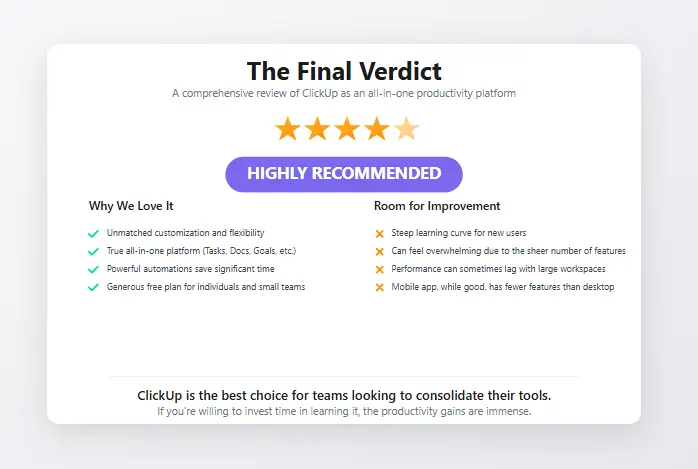
ClickUp is an impressive project management tool that offers an extensive feature set, extensive customization options, and good value for money. Its all-in-one approach makes it an attractive option for teams looking to consolidate multiple tools into one platform. The generous free plan is particularly appealing for small teams or those on a tight budget. This ClickUp review found the overall package to be compelling.
However, ClickUp’s extensive feature set can also be a drawback. The platform has a steep learning curve, and new users might find it overwhelming initially. Some users also report occasional performance issues, particularly when working with large amounts of data. This ClickUp review acknowledges these are important considerations.
For teams that value customization and want a comprehensive solution that can adapt to their specific needs, ClickUp is an excellent choice. Its flexibility makes it suitable for a wide range of industries and use cases, from software development to marketing to creative agencies. This ClickUp review highly recommends it for such teams.
On the other hand, teams that prefer simple, straightforward tools might find ClickUp too complex. Additionally, organizations with highly specialized needs might require more specialized solutions. This ClickUp review aims to provide a balanced perspective.
Overall, our ClickUp review found that it’s a powerful, versatile project management tool that offers good value for money. While it might not be the perfect solution for every team, it’s definitely worth considering if you’re looking for a comprehensive, customizable project management platform. This ClickUp review concludes it’s a market leader.
If you’re interested in trying ClickUp for yourself, you can start with the Free plan to explore the platform’s features before committing to a paid plan. With its generous free plan and extensive feature set, ClickUp is definitely worth a try for teams looking to improve their project management processes. This final ClickUp review recommendation is to give it a go.
Frequently Asked Questions About ClickUp
To conclude our ClickUp review, we’ve compiled answers to some of the most commonly asked questions about the platform. This ClickUp review FAQ section addresses key queries.
