
Monday.com vs ClickUp: The Ultimate 2026 Comparison
Choosing the right project management tool can transform your team’s productivity. Our comprehensive monday.com vs ClickUp analysis reveals which platform comes out on top for different business needs.
Try Monday.com Free Try ClickUp FreeThe Battle of Project Management Titans: Monday.com vs ClickUp
In today’s fast-paced business environment, selecting the right project management software is crucial for team success. The monday.com vs ClickUp debate has been ongoing as both platforms have evolved to become leading solutions in the market. When comparing monday.com vs ClickUp, it’s essential to understand that both offer powerful features but cater to different workflows and preferences.
Our comprehensive monday.com vs ClickUp analysis will help you make an informed decision based on your specific needs. Whether you’re a small business owner, a project manager, or part of a large enterprise, understanding the nuances of monday.com vs ClickUp will save you time and resources in the long run.
Throughout this monday.com vs ClickUp comparison, we’ll examine key features, pricing structures, user interfaces, integration capabilities, and much more. By the end of this guide, you’ll have a clear understanding of which platform in the monday.com vs ClickUp battle aligns best with your team’s workflow and objectives.
Disclosure: This article contains affiliate links. If you sign up through our links, we may earn a commission at no additional cost to you. This helps us maintain our site and continue providing valuable content. Our monday.com vs ClickUp comparison remains unbiased regardless of any affiliate relationships.
Quick Comparison: Monday.com vs ClickUp at a Glance
| Feature | Monday.com | ClickUp |
|---|---|---|
| Starting Price | $8/user/month (billed annually) | $5/user/month (billed annually) |
| Free Plan | Available (limited features) | Available (generous features) |
| Best For | Visual project management, team collaboration | All-in-one workspace, customization |
| User Interface | Colorful, intuitive, visual | Modern, customizable, feature-rich |
| Learning Curve | Moderate | Steeper due to extensive features |
| Mobile App | Excellent (iOS & Android) | Good (iOS & Android) |
| Integrations | 200+ integrations | 1000+ integrations |
| Automation | Advanced automation capabilities | Extensive automation options |
Detailed Feature Comparison: Monday.com vs ClickUp
When evaluating monday.com vs ClickUp, it’s crucial to understand how each platform performs in key areas. Let’s dive deeper into the features that set these two project management giants apart.
User Interface & Experience
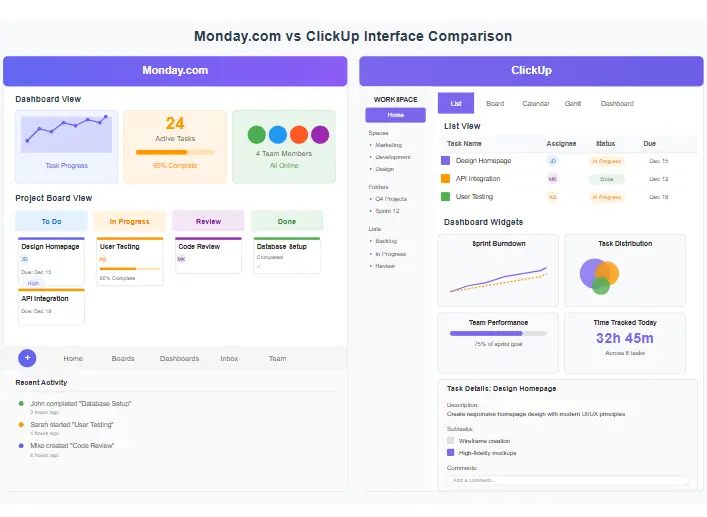
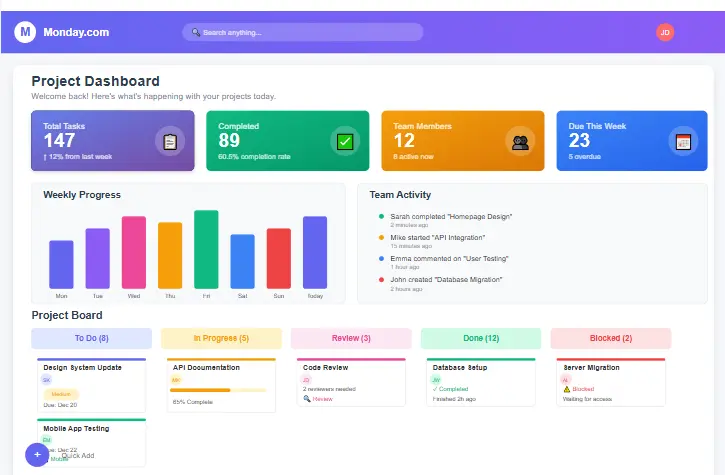
In the monday.com vs ClickUp UI battle, monday.com stands out with its colorful, visually appealing interface that’s immediately intuitive for most users. The platform uses a board-based system similar to Kanban but with more customization options. Monday.com’s interface is clean, modern, and makes extensive use of color coding to help users quickly identify project status, priorities, and team assignments.
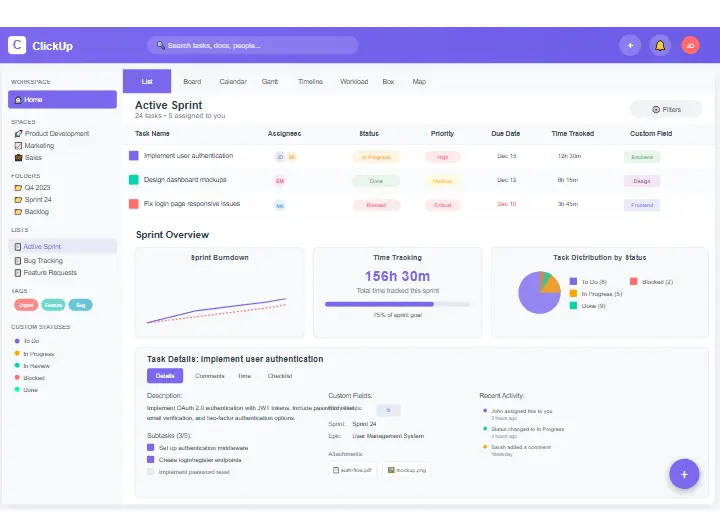
ClickUp, on the other hand, offers a more comprehensive but potentially overwhelming interface. It provides multiple views including List, Board, Calendar, Gantt, and more. While highly customizable, the sheer number of features in ClickUp can create a steeper learning curve compared to monday.com. However, once mastered, ClickUp’s interface offers unparalleled flexibility in how you visualize and manage your work.
For teams that value visual appeal and quick adoption, monday.com often wins in the monday.com vs ClickUp interface comparison. For teams that prioritize customization and are willing to invest time in learning, ClickUp provides more options to tailor the workspace to specific needs.
Project Management Capabilities
When comparing monday.com vs ClickUp for project management, both platforms offer robust solutions but with different approaches. Monday.com excels in visual project management with its board-based system that makes it easy to track progress at a glance. The platform’s timeline and Gantt chart views are intuitive and help teams visualize project dependencies and deadlines.
ClickUp takes a more comprehensive approach, positioning itself as an “all-in-one” workspace. It offers more granular task management with features like custom statuses, priorities, checklists, and time tracking. ClickUp’s project management capabilities are more extensive, with features like goals, portfolios, and workload management that go beyond what monday.com offers in its base plans.
In the monday.com vs ClickUp project management comparison, your choice depends on your needs. If you prefer straightforward visual project management, monday.com is ideal. If you need more detailed project tracking with advanced features, ClickUp might be the better option.
Collaboration Features
Both platforms excel in team collaboration, but with different strengths. Monday.com offers excellent communication features including @mentions, file sharing, comments, and team updates. The platform’s “Update” feature allows team members to share progress with stakeholders without overwhelming them with project details.
ClickUp provides more extensive collaboration tools, including comments, assignments, proofing and annotations, shared views, and real-time collaboration. ClickUp’s “Docs” feature allows teams to create documents within the platform, a capability that monday.com lacks in its core offering.
In the monday.com vs ClickUp collaboration comparison, ClickUp offers more features for teams that need extensive documentation and proofing capabilities. Monday.com, however, provides a more streamlined approach that may be preferable for teams that want to keep communication focused on task execution.
Customization & Flexibility
ClickUp clearly dominates in the monday.com vs ClickUp customization battle. The platform allows users to customize almost every aspect of their workspace, from task statuses and priorities to custom fields and views. ClickUp’s flexibility is unmatched, making it adaptable to virtually any workflow or industry.
Monday.com also offers good customization options, including custom columns, dashboards, and automations. However, it’s more structured than ClickUp, which can be either a benefit or limitation depending on your needs. Monday.com’s approach to customization is more guided, helping users create effective workflows without overwhelming them with options.
If your team requires extensive customization and the ability to tailor every aspect of your project management tool, ClickUp wins the monday.com vs ClickUp customization comparison. If you prefer a more structured approach with guided customization, monday.com might be the better choice.
Automation Capabilities
Both monday.com and ClickUp offer powerful automation features, but with different approaches. Monday.com provides an intuitive automation builder that allows users to create “recipes” for common workflows. The platform’s automations are easy to set up and cover most common use cases, such as status changes, notifications, and task assignments.
ClickUp offers more extensive automation capabilities through its “Automations” feature. The platform provides more triggers, actions, and conditions, allowing for more complex workflows. ClickUp also offers custom automation for enterprise plans, providing even more flexibility for large organizations.
In the monday.com vs ClickUp automation comparison, ClickUp offers more advanced capabilities, while monday.com provides a more user-friendly experience for setting up basic automations. Your choice depends on whether you prioritize ease of use (monday.com) or advanced functionality (ClickUp).
Integration Ecosystem
When it comes to integrations, ClickUp has a significant advantage in the monday.com vs ClickUp comparison. With over 1000 native integrations, ClickUp connects with virtually every tool your team might be using, from communication platforms like Slack and Microsoft Teams to development tools like GitHub and GitLab.
Monday.com offers around 200 integrations, which covers most essential business tools but is more limited than ClickUp’s ecosystem. Monday.com does offer a robust API for custom integrations, and its most popular integrations include Slack, Google Drive, Microsoft Teams, and Zoom.
If integration with a wide variety of tools is crucial for your workflow, ClickUp clearly wins the monday.com vs ClickUp integration battle. However, if you primarily use standard business tools, monday.com’s integration options will likely suffice.
Pricing Comparison: Monday.com vs ClickUp
Understanding the pricing structure is essential when evaluating monday.com vs ClickUp. Both platforms offer tiered pricing with different features at each level, but their approaches to pricing differ significantly.
Monday.com Pricing
For individuals looking to keep track of their work
- Up to 2 seats
- 200+ templates
- Unlimited boards
- 5 GB storage
ClickUp Pricing
For personal use or for your team to try ClickUp
- Unlimited tasks
- Unlimited members
- Unlimited free plan users
- 100 MB storage
Monday.com Basic
For teams looking to manage any type of work
- Unlimited boards
- 5 GB storage
- Unlimited viewers
- 200+ templates
- Android & iOS apps
ClickUp Unlimited
For small teams needing to manage projects & collaborate
- Unlimited everything
- Unlimited storage
- Integrations
- Advanced automations
- Guests
For detailed pricing information, check out our ClickUp pricing guide and comprehensive pricing comparison with other project management tools.
Use Case Scenarios: When to Choose Monday.com vs ClickUp
The monday.com vs ClickUp decision often comes down to specific use cases. Let’s explore scenarios where each platform excels.
Choose Monday.com If:
- You prioritize visual project management with colorful, intuitive interfaces
- Your team needs a tool with a shorter learning curve
- You work in creative industries where visual appeal matters
- You prefer a more structured approach to project management
- You need strong client-facing capabilities
- Your team values simplicity over extensive features
- You’re managing projects with clear, linear workflows
Choose ClickUp If:
- You need an all-in-one workspace that replaces multiple tools
- Your team requires extensive customization options
- You’re managing complex projects with many variables
- You need granular control over task management
- Your team is tech-savvy and willing to invest time in learning
- You need advanced reporting and analytics capabilities
- You’re looking for a budget-friendly option with generous features
Monday.com Pros
- Visually appealing and intuitive interface
- Shorter learning curve compared to ClickUp
- Excellent mobile apps for iOS and Android
- Strong client-facing features
- Great for visual project management
- Reliable customer support
- Robust automation capabilities
Monday.com Cons
- More expensive than ClickUp for similar features
- Limited customization compared to ClickUp
- Fewer integrations available
- Less comprehensive feature set
- Can become expensive as team grows
- Limited reporting in lower-tier plans
- No built-in documentation feature
ClickUp Pros
- Generous free plan with extensive features
- Highly customizable to fit any workflow
- More affordable than monday.com
- All-in-one approach reduces need for multiple tools
- Extensive integration ecosystem
- Advanced automation capabilities
- Comprehensive feature set
ClickUp Cons
- Steeper learning curve due to extensive features
- Can feel overwhelming for new users
- Interface can be less intuitive than monday.com
- Mobile apps not as polished as monday.com
- Performance can sometimes lag with large datasets
- Customer support response times can be slow
- Occasional bugs with new feature releases
Real-World Performance: Monday.com vs ClickUp
Beyond features and pricing, how do these platforms perform in real-world scenarios? Our monday.com vs ClickUp analysis wouldn’t be complete without examining practical performance aspects.
Speed & Performance
In terms of raw performance, monday.com generally offers faster loading times and smoother navigation, especially when dealing with large boards with many items. The platform’s interface is optimized for quick loading and responsive interactions, which contributes to its user-friendly experience.
ClickUp, with its extensive feature set, can sometimes experience slower loading times, particularly when switching between different views or when working with large datasets. However, ClickUp has made significant performance improvements in recent updates, and for most teams, the performance difference between monday.com vs ClickUp is negligible.
For teams that prioritize speed and responsiveness, monday.com might have a slight edge in the monday.com vs ClickUp performance comparison.
Reliability & Uptime
Both platforms boast impressive uptime records, with both monday.com and ClickUp maintaining 99.9% uptime over the past year. This means that regardless of which platform you choose in the monday.com vs ClickUp decision, you can expect reliable service.
Monday.com has a slightly longer track record of stability, having been in the market longer than ClickUp. However, ClickUp has demonstrated consistent reliability and continues to improve its infrastructure to handle its growing user base.
In terms of reliability, the monday.com vs ClickUp comparison is essentially a tie, with both platforms offering dependable service for critical business operations.
Customer Support
When it comes to customer support, monday.com generally receives higher marks for responsiveness and quality of support. The platform offers 24/7 support for all paid plans, with faster response times for higher-tier plans. Monday.com’s support team is known for being knowledgeable and helpful in resolving issues.
ClickUp offers support through email and chat, with phone support available for Enterprise plans. While ClickUp’s support is generally helpful, response times can sometimes be longer, especially for users on lower-tier plans.
If customer support is a priority in your monday.com vs ClickUp decision, monday.com might have a slight advantage, particularly for teams that require immediate assistance.
Security & Compliance: Monday.com vs ClickUp
For businesses handling sensitive data, security features are a critical factor in the monday.com vs ClickUp decision.
Data Security
Both monday.com and ClickUp take data security seriously, employing industry-standard encryption for data both in transit and at rest. Both platforms comply with GDPR and offer features like two-factor authentication (2FA) to enhance account security.
Monday.com offers more advanced security features in its Enterprise plan, including IP restrictions, custom SAML, and audit logs. ClickUp also provides enterprise-grade security features, but some of these are only available in its highest-tier plans.
For most businesses, both platforms in the monday.com vs ClickUp comparison offer adequate security measures. However, enterprises with specific security requirements should carefully evaluate the features available in each platform’s enterprise plans.
Compliance & Certifications
Monday.com holds several compliance certifications, including SOC 2 Type II, GDPR, and HIPAA compliance for certain plans. These certifications make monday.com a strong choice for businesses in regulated industries like healthcare and finance.
ClickUp also maintains GDPR compliance and has obtained SOC 2 Type II certification. However, ClickUp’s HIPAA compliance options are more limited compared to monday.com.
If compliance with specific regulations is a key factor in your monday.com vs ClickUp evaluation, monday.com might have a slight edge, particularly for healthcare organizations requiring HIPAA compliance.
The Final Verdict: Monday.com vs ClickUp
After our comprehensive monday.com vs ClickUp analysis, it’s clear that both platforms offer excellent solutions for project management, but they excel in different areas. The choice between monday.com vs ClickUp ultimately depends on your specific needs, preferences, and budget.
Choose Monday.com if you value visual appeal, ease of use, and a shorter learning curve. It’s an excellent choice for creative teams, client-facing projects, and organizations that prioritize a polished user experience.
Choose ClickUp if you need an all-in-one solution with extensive customization options and advanced features. It’s ideal for tech-savvy teams, complex projects, and organizations looking to consolidate multiple tools into one platform.
Both platforms offer free trials, so we recommend testing both to see which one better fits your workflow. The monday.com vs ClickUp decision is personal, and hands-on experience is the best way to make the right choice for your team.
Frequently Asked Questions: Monday.com vs ClickUp
For small businesses with limited budgets, ClickUp often provides better value due to its more generous free plan and lower-priced paid tiers. However, if your small business prioritizes ease of use and visual project management, monday.com might be worth the additional investment.
Yes, both platforms offer migration options. ClickUp provides a monday.com importer that allows you to transfer your boards, tasks, and more. While monday.com doesn’t have a direct ClickUp importer, you can export data from ClickUp and import it into monday.com using CSV files.
Both monday.com and ClickUp are excellent for remote teams. Monday.com offers more intuitive communication features and a cleaner interface that remote teams may find easier to adopt. ClickUp provides more comprehensive features that can replace multiple tools, which might be beneficial for remote teams looking to consolidate their tech stack.
Monday.com generally receives higher marks for its mobile apps, which are more polished and user-friendly. ClickUp’s mobile apps are functional and comprehensive but can feel less intuitive compared to monday.com’s offerings.
ClickUp includes built-in time tracking features even in its free plan, with more advanced time tracking capabilities in paid plans. Monday.com offers time tracking as well, but it’s only available in paid plans and is generally considered less comprehensive than ClickUp’s offering.
Alternative Project Management Solutions
While monday.com vs ClickUp are both excellent choices, they’re not the only project management tools on the market. If you’re still undecided after our monday.com vs ClickUp comparison, consider these alternatives:
Wrike
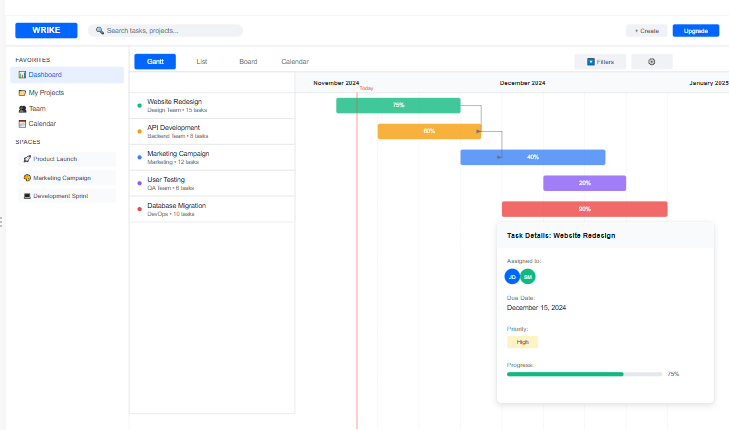
Wrike is a powerful project management tool that offers robust features for team collaboration and project tracking. It provides excellent Gantt chart capabilities and advanced reporting. For a detailed comparison, check out our Wrike project management software review.
Asana
Asana is another popular project management tool known for its clean interface and ease of use. It offers strong team collaboration features and integrates well with other business tools. Asana is a good middle ground between the simplicity of monday.com and the comprehensive features of ClickUp.
Trello
Trello uses a simple Kanban board approach that’s highly intuitive and easy to adopt. While it lacks the advanced features of monday.com and ClickUp, it’s an excellent choice for teams with simple project management needs or those new to project management tools.
Final Thoughts on the Monday.com vs ClickUp Debate
The monday.com vs ClickUp comparison reveals two exceptional project management platforms that cater to different needs and preferences. Rather than declaring a definitive winner in the monday.com vs ClickUp battle, it’s more helpful to understand which tool aligns best with your specific requirements.
Monday.com shines with its visual appeal, intuitive interface, and shorter learning curve, making it ideal for teams that value aesthetics and ease of adoption. Its colorful boards and straightforward approach to project management make it particularly appealing to creative industries and client-facing businesses.
ClickUp, on the other hand, offers unparalleled customization and a comprehensive feature set that can replace multiple tools. Its all-in-one approach makes it attractive to tech-savvy teams and organizations looking to consolidate their project management, documentation, and collaboration tools into a single platform.
Ultimately, the monday.com vs ClickUp decision comes down to your team’s specific needs, budget constraints, and technical expertise. We recommend taking advantage of both platforms’ free trials to experience their interfaces and features firsthand before making your final decision.
For more detailed information about these platforms, check out our comprehensive ClickUp review and explore how these tools compare to other project management solutions.